
What happens in the 200ms after a goal, and the three minutes after the whistle
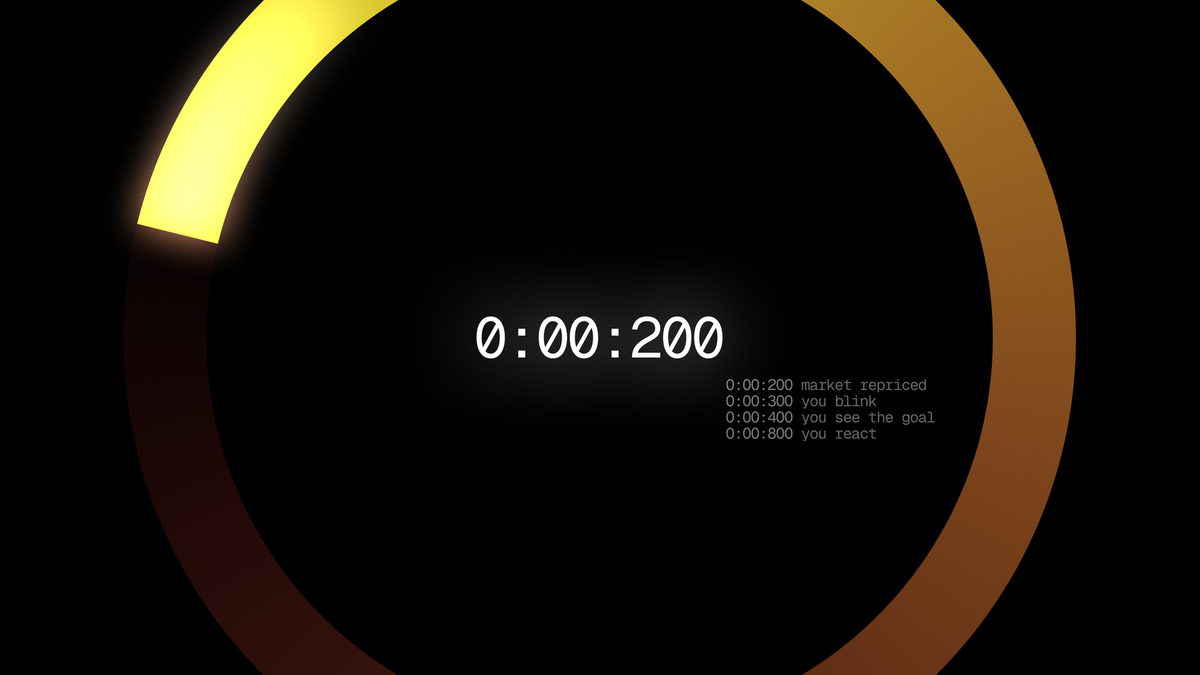
Live sports trading is two speed problems, not one. The first is execution: matching a trade and updating every screen inside 200 milliseconds. The second is resolution: settling the market within minutes of the result, not the hours a general prediction exchange takes. Most products are built for neither.
A striker hits the top corner in the 73rd minute. Before the net stops moving, price needs to be somewhere new.
If you're on the wrong side of that move and you don't get out before the new price prints, you've been picked off. If you saw the build-up and wanted to add to your position, you need liquidity waiting at a tight spread the moment the market updates. Every part of that sequence is an engineering problem.
Pred is built for both clocks. Trades execute in about 200 milliseconds. Markets resolve and settle within three to four minutes of the outcome being confirmed. Financial markets have been solving versions of these problems for decades. Sports products mostly haven't.
Sports trading is a latency problem
Trading venues have spent decades driving execution latency down to microseconds. A stale quote is a loss. A slow fill is a loss. The same discipline works in sports. The assumption of continuous price discovery doesn't.
In equities, FX and rates, information arrives continuously. Flow is granular. Price discovery is a gradient. A participant who is a few milliseconds late pays a marginal cost over thousands of trades.
Sports works the opposite way. Information arrives in discrete shocks. A goal, a red card, a keeper going down, a VAR overturn. Between those events the market drifts on variables like possession, territory and xG. At the event, price breaks. The distribution of outcomes resets in one instant, and every open order written against the old distribution is suddenly mispriced.
Watch the order book during that reset. A second before the ball crosses the line, the book is layered with resting orders priced against the pre-event distribution. At the event, half those orders are wrong before the crowd has finished reacting. Some traders pull them. Others get picked off. New orders arrive from traders who believe they read the moment before the market did. The book rebuilds at a new level. The whole sequence, from the ball hitting the net to liquidity re-clustering at a fair price, unfolds in seconds. Everything inside that window is latency-bound.
Latency matters more in a sports market than almost anywhere else. The cost of being slow is concentrated and repeated, every time something happens on the pitch.
Why sportsbooks suspend the market
Sportsbooks handle discrete shocks with a blunt tool. When the event happens, the book suspends the market. Twenty seconds. Sometimes longer. The book recalibrates and reopens with a new price. Users who were mid-click get their action voided or held.
From the operator's side this is rational. The book is the counterparty to every position. If its price is stale and users can see new information before the price updates, the book loses on every trade. Suspension is how the sportsbook model survives.
From the user's side it is the single most frustrating moment in live sports trading. You watched the build-up. You had a view. The market goes dark right when your view is sharpest. When it reopens, the price has already moved past where you would have paid.
Why an exchange can't do that
On a peer-to-peer exchange, users trade against each other. No house book sits in the middle taking the other side. That changes the speed problem at the root.
When a goal goes in, someone on the exchange wants to sell and someone wants to buy. Slow matching means the seller prints at a stale price and loses value to the buyer.
Slow propagation is worse than it sounds. If the matching engine publishes a new price and it reaches some clients faster than others, users on faster connections can trade against resting orders that slower-connected users haven't yet seen. That isn't a feature of the architecture. It's a tax on the user with worse network latency. Every serious exchange works to minimise it. Most sportsbook products have never had to, because there is no user-to-user trading to unbalance.
A slow client means the user can't act on what they can already see. The match is live on their screen. The market on their screen is a few beats behind. They click and nothing happens in the seconds their view was sharpest.
The latency target isn't just the match clock. It's the fastest-informed user on the exchange. Broadcast feeds are never in real time. Cable and satellite run several seconds behind. Streaming can be a minute or more. In-stadium fans see the goal first. Traders watching reactions on X often react before their own feed catches up. The market has to keep up with the fastest path any user might be on.
You can't suspend your way out of this. Suspension on an exchange means users can't transact with each other, which defeats the point of the architecture. The only answer is to build the system so that every stage of the execution path, from order entry to the pixel on the screen, runs inside the window where the market still reflects the match.
For sports that window is 200ms. At that threshold the experience stops feeling laggy and starts feeling live.
The execution clock: what 200ms actually requires
200ms is the execution number. It covers the path from order entry to fill to the pixel on the screen. Reaching it takes a set of compounding choices.
Order matching runs on infrastructure that doesn't queue under load. Price publication reaches every connected client at the same time, so no screen is richer than another. Risk checks sit in the critical path without adding meaningful delay. The client renders state changes as they happen, not on a poll cycle. Settlement on Base sits off the hot path, so confirmation latency never becomes execution latency.
None of these problems are new. Every serious equity venue and every crypto exchange with real volume has solved versions of them. What is new is applying the same engineering standard to sports. The category has been built on the assumption that users will tolerate suspensions and stale prints because the alternative didn't exist.
200ms at launch is different from 200ms at peak load across every market on a Champions League night. Holding the number as load scales is the engineering problem the exchange will keep working on for as long as it operates.
The resolution clock: minutes, not hours
Execution is only half the problem. The other half is what happens after the whistle.
Prediction exchanges built for other categories face both halves and were designed for neither. Engineers built them for political and macro markets, where volume arrives over hours and events resolve on a news cycle. Sports concentrates volume in seconds around a goal. A matching engine that handles election volume comfortably can stall under the order flow that arrives in the 90 seconds after a red card.
Resolution is where the gap is widest. Most general prediction exchanges settle through an optimistic oracle with a built-in challenge window. On Polymarket, that window is roughly two hours before a market finalizes, even when the outcome is obvious, and a single dispute pushes resolution to several days. The design is rational for "who won the election," where the cost of getting it wrong is catastrophic and the value of getting it right fast is low. Sports inverts both. Every market on the pitch is binary and instant. A market that finalizes two hours after the whistle leaves user capital stuck in a market with nothing left to trade on.
Resolution speed in sports has to match execution speed. Pred resolves against match state and settles on Base, so a market closes within three to four minutes of the outcome being confirmed. Winning capital is freed to trade the next market while the same result is still printing on a competitor. Oracle windows built for political markets can't do that, and extending a political-markets exchange into sports doesn't fix it. The teams that built those exchanges designed for a different tempo.
| When a goal or red card hits | Trade execution | Market resolution | Counterparty |
|---|---|---|---|
| Sportsbook: suspends the market, recalculates, reopens (20s or more) | You trade the book's price; mid-click action can be voided | Minutes to hours, graded by the operator | The house book takes the other side; winning accounts can be limited |
| General prediction exchange: keeps trading, but matching can stall under burst flow | Built for slow flow, not second-by-second sports bursts | ~2 hour challenge window minimum; days if disputed | Other users, settled on-chain |
| Pred: keeps trading, matching holds through the burst | ~200ms from order entry to fill to screen | 3-4 minutes from confirmed outcome, settled on Base | Other traders on a transparent, peer-to-peer order book |
What speed doesn't fix
Speed is a floor. At 200ms the product stops feeling laggy and starts feeling live. Above it, nothing else works. Clearing the floor doesn't make a market good on its own.
Tight spreads come from liquidity, and liquidity comes from market makers, volume and time. A fast exchange with thin order books still disappoints the user trying to put size on. Depth at size is an independent problem from execution latency. So is market selection. So is the quality of the settlement experience. So is the UX of placing an order and understanding the fill.
Speed is necessary. Exchanges that win this category will clear the latency floor and then compete on liquidity, market selection, risk infrastructure and product design for years after that. None of the rest matters without the first.
Speed as the product
Users don't read latency numbers. They feel them. What they feel on a fast exchange is that the market tracks the match. Price moves when something happens. Orders fill. The market resolves while the result is fresh and pays out before they've left the app. The whole thing stays alive in the seconds they most want to act.
When a goal goes in at Anfield, the market on their phone reflects it while they are still on their feet. When VAR overturns a penalty, they can act before the replay finishes. When the final whistle blows, the market settles in the time it takes to read the post-match reaction. That experience is the product.
You don't add that in version two. It gets decided in the first architectural review and defended in every engineering trade-off after that. Build it right and trading a live match feels like watching it with a real market next to you. Get it wrong and you are selling users a slower, more expensive version of what they can already get from a sportsbook.
A striker hits the top corner in the 73rd minute. 200ms later, you know whether the exchange you are on was built for the sport or retrofitted to it. Three minutes after the whistle, you know it again.
FAQ
How fast does a trade execute on a sports exchange like Pred?
On Pred, a trade executes in around 200 milliseconds. That window covers order matching, publishing the new price to every connected client at the same moment, and rendering the change on screen. At that threshold the market stops feeling laggy and starts tracking the match in real time.
How long does Pred take to resolve and settle a market?
Pred resolves and settles markets within three to four minutes of the outcome being confirmed. The result is read from match state and settled on Base, so winning capital is freed to trade again almost immediately rather than sitting locked while the market waits to finalize.
Why do sportsbooks suspend the market when a goal is scored?
A sportsbook is the counterparty to every position, so a stale price loses it money on every trade. When a goal resets the odds, the book suspends the market for twenty seconds or more, recalculates, and reopens at a new price. Action placed mid-click is voided or held.
Why can general prediction exchanges take hours to resolve a sports market?
Most prediction exchanges resolve through an optimistic oracle with a mandatory challenge window, commonly around two hours, before any market finalizes, even when the result is obvious. A single dispute pushes that to several days. The design fits slow-moving political markets, not a match that ends on a whistle.
Pred is a peer-to-peer sports exchange built on Base. Traders match against each other in live sports markets, with no house book taking the other side.