
What is a lay bet? How laying works, and why a No contract is the same position
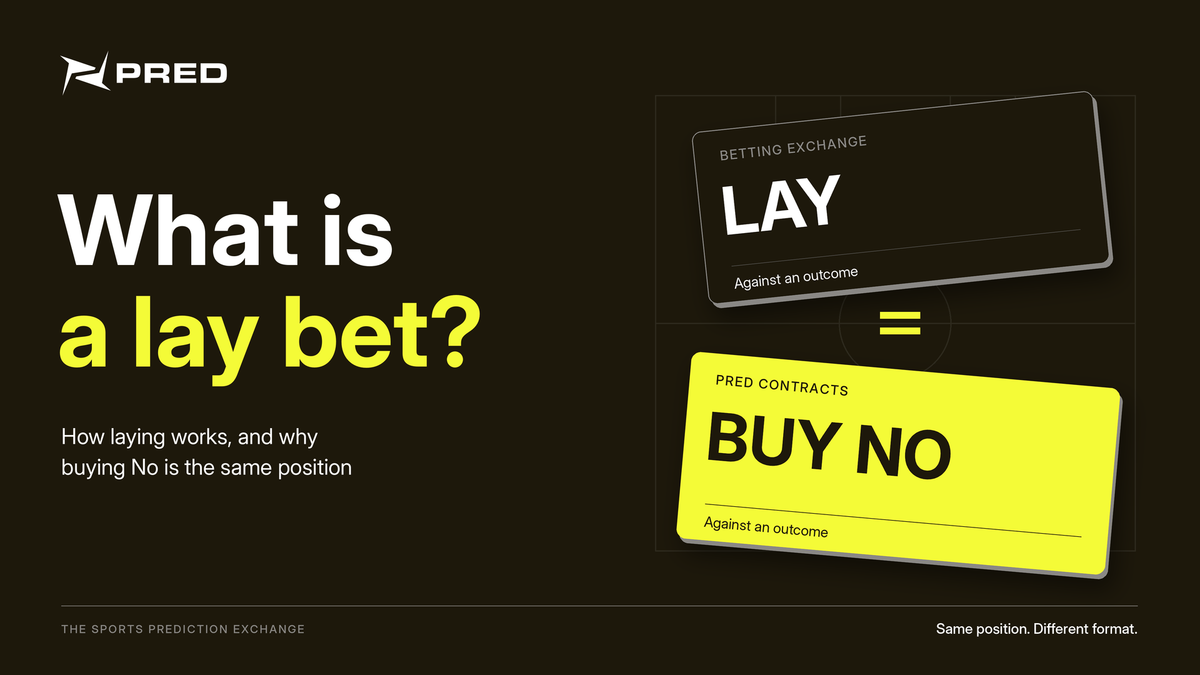
TL;DR: A lay bet is a bet against an outcome: you win if it doesn't happen. On a betting exchange you take the other side of a customer who is backing that outcome, and if it happens you pay them out. That payout is your liability, calculated as the backer's stake × (odds − 1). On a Yes/No exchange such as Pred, the same position is called buying No. Laying £10 at 2.50 risks £15 to win £10, and 25 No contracts at 60p risk the same £15 to win the same £10.
How a lay bet works
Betfair's help centre defines laying as backing something not to happen. Lay Arsenal to beat Chelsea and a Chelsea win or a draw pays you, while an Arsenal win costs you.
The exchange matches your lay with one or more customers backing Arsenal at your price and holds both sides' money until the result. Betfair's help page calls this a pot. In its example, a customer backs a golfer at 32 for £10, the layer puts up £310, and the £320 goes to whoever is right, less Betfair's commission on the winner's net winnings in that market.
Smarkets' help page says a layer plays the role of a bookmaker. The comparison holds for the payout, since you pay out when the selection wins and keep the stake when it loses. On price it falls apart: a bookmaker sets its own prices and builds a margin into each one, while a layer takes a price another customer has posted, or posts one and waits for a backer to take it.
How to calculate lay liability
Liability is the backer's stake multiplied by the odds minus one.
Liability = backer's stake × (odds − 1)
Lay Arsenal at 2.50 with a £10 backer's stake and your liability is £10 × 1.5, which is £15. The exchange holds that £15 from your balance, because it is the most you can lose. If Arsenal win, it goes to the backer. If the match is drawn or Chelsea win, you collect the backer's £10 less commission, and at a 2% rate you keep £9.80.
The stake you type on Betfair, Smarkets and Matchbook is the backer's stake, the amount you stand to win. The exchange works out your liability from the odds, and all three spend part of their help pages on the gap between the two. Matchbook's guide lays Real Madrid for €50 at 1.5 and spells out that the €50 is the win and the €25 liability is the risk.
Liability climbs with the price. Betfair's page gives both ends: laying a horse at 1.91 risks £9.10 to win £10, and laying the draw in a football match at 13.5 risks £125 to win the same £10. Run your own numbers below. The second panel shows each lay as No contracts.
Enter the lay odds and either the backer's stake, which is what you win, or your liability, which is what you risk. The second panel shows the same position as No contracts.
After 2% commission on the £10.00 you win. The pot is the backer's £10.00 plus your £15.00.
Before trading fees. Each No contract pays £1 if the selection fails to win.
The matching Yes price is 40.0p, a 40% implied chance that the selection wins.
Why is buying No the same position?
A Yes/No exchange quotes each outcome as a pair of contracts. On Pred, a Yes contract pays $1 if the outcome happens and nothing if it doesn't, and a No contract pays $1 if it doesn't happen. Pred's documentation describes each contract as a match between a Yes buyer and a No buyer, whose payments add up to the $1 the winner collects.
That is Betfair's pot, counted in contracts. The Yes buyer is the backer, paying the backer's stake; the No buyer is the layer, paying the liability; and the $1 each contract pays out is the pot.
Converting a lay takes one division. The Yes price is 1 divided by the decimal odds and the No price is 1 minus the Yes price, so odds of 2.50 become a Yes price of 40p and a No price of 60p. To rebuild any lay as No contracts:
- No price = 1 − 1/odds
- Contracts = backer's stake × odds
- Cost of the contracts = your liability
For the Arsenal lay, that is 25 No contracts at 60p. They cost £15 and pay £25 if Arsenal fail to win, so you make £10 or lose £15, the same two outcomes as the lay before costs. Pred's contracts pay out in dollars, and the sums work the same way in any currency, so the examples here stay in pounds to match the exchanges' help pages.
| Lay odds | Risk to win £10 | Yes price | No price |
|---|---|---|---|
| 1.50 | £5.00 | 66.7p | 33.3p |
| 1.91 | £9.10 | 52.4p | 47.6p |
| 2.00 | £10.00 | 50.0p | 50.0p |
| 2.50 | £15.00 | 40.0p | 60.0p |
| 3.40 | £24.00 | 29.4p | 70.6p |
| 4.00 | £30.00 | 25.0p | 75.0p |
| 10.00 | £90.00 | 10.0p | 90.0p |
| 13.50 | £125.00 | 7.4p | 92.6p |
The risk column applies to the lay and to the No contracts alike. Prices are rounded to a tenth of a penny.
The two differ in the number you type. A Yes/No order asks how much you want to spend at the No price, or how many contracts you want, so the figure you enter is the most you can lose. The price doubles as a probability: No at 60p is the market's 60% chance that Arsenal fail to win.
Betfair now runs a version of this on its own exchange. Betfair Predicts, in beta for selected customers, has you pick Yes or No and enter a stake, and trades on the liquidity already on the Betfair Exchange.
Where can you lay?
You can lay on a betting exchange or on a Yes/No exchange. A sportsbook has no lay side.
Betfair Exchange, Smarkets and Matchbook show a back price and a lay price for every selection, and each covers laying in its own help material. Our comparison of Betfair alternatives sets out what else separates them.
On a Yes/No exchange you buy No. Every Pred market has a No side, the draw included: football fixtures carry separate markets for the home side, the draw and the away side, so laying the draw means buying No on the draw market. Our piece on prediction exchanges and betting exchanges covers where the two models differ.
At a sportsbook, opposing Arsenal means backing every other outcome, either the draw and Chelsea as two bets or a double chance market that covers both. Matchbook's guide puts the same choice to its readers for Tottenham at home to Chelsea: back the draw and Chelsea, or lay Tottenham. The sportsbook prices both of those bets with its margin built in.
Closing a lay before full time
You can close a lay before the final whistle. Betfair's help page calls laying first and backing the same selection later in-play trading, and Smarkets describes backing at a higher price than you laid to lock in a profit on every outcome.
Take the Arsenal lay at 2.50. Chelsea score first and Arsenal drift to 4.00. The back stake that gives you the same profit on every result is the lay stake × lay odds ÷ current odds: £10 × 2.50 ÷ 4.00, or £6.25. Back Arsenal for £6.25 at 4.00. If Arsenal win, the back makes £18.75 and the lay costs £15. If they don't, the lay pays £10 and the back loses £6.25. Both routes leave you £3.75 up, and because Betfair charges commission on net winnings in each market, its commission is worked out on that £3.75.
On a Yes/No exchange you sell the No contracts. Arsenal at 4.00 is a Yes price of 25p and a No price of 75p. If No is bid at 75p, your 25 contracts sell for £18.75 against the £15 they cost: the same £3.75. On Pred, another trader sets that price: you sell into the best bid on the order book. You can also sell part of a position and keep the rest.
Common questions
What is the difference between a back bet and a lay bet? A back bet wins if the selection wins, and a lay bet wins if it doesn't. Backing risks your stake. Laying risks your liability, which rises with the odds, and the most it can win is the backer's stake. On a Yes/No exchange, backing is buying Yes and laying is buying No.
How do you calculate lay bet winnings? Multiply the backer's stake by the odds minus one to get your liability. Smarkets' own example lays a horse at 3.40 for £10, which puts £24 at risk. If the selection loses, you win the £10 backer's stake, less the exchange's commission on net winnings. If it wins, you lose the £24.
Can you lay a bet with a bookmaker? No. A bookmaker only takes back bets, because it sets the prices and stands on the other side itself. The nearest equivalent is backing every other outcome, such as the draw and the away win, or a double chance market, and those prices include the bookmaker's margin. Laying needs an exchange, where another customer takes the back side.
Is buying No on a prediction exchange the same as laying? The payoff is the same. A lay at decimal odds D matches buying No at a price of 1 − 1/D. At 2.50 that is 60p: laying £10 risks £15 to win £10, and so do 25 No contracts at 60p. Only the input differs: an exchange asks for the backer's stake, a Yes/No order for what you want to spend.
What does laying the draw mean? Laying the draw is taking the position that a football match won't end level. A common version lays it before kick-off and backs it after a goal, once the draw price has lengthened, locking in a profit on every result. On Pred the draw has its own market, so the equivalent is buying No on it and selling after a goal.
Do you pay commission on a losing lay? Not on Betfair. It charges commission on net winnings in each market, so a lay that loses leaves nothing to charge. A winning lay pays commission on the backer's stake you collect. If you back and lay in the same market, the commission is worked out on the net result of both. Our commission comparison covers what each exchange charges.