
What Polymarket Got Right (And What Comes Next)
The 2024 election did something unusual: it made prediction markets cool.
For years, these platforms existed on the fringes, interesting to a small crowd of quants and crypto-natives, largely ignored by everyone else. Then Polymarket happened. Suddenly, prediction markets weren't just an academic curiosity. They were on Bloomberg terminals. Pundits were citing them on cable news. Regular people were checking odds alongside polling averages.
Polymarket didn't invent prediction markets. But they made them matter. And in doing so, they proved something important: there's real demand for trading on real-world outcomes. Not just among degens looking for action, but among people who want to express a view, back their analysis, and have skin in the game.
That matters. It's worth sitting with for a moment.
Give Credit Where It's Due
It's easy to be cynical about success. To pick apart what could've been better, to find the cracks. But intellectual honesty requires acknowledging what Polymarket actually accomplished.
They solved liquidity, the cold start problem that kills most prediction markets before they begin. They built a product that didn't feel like a crypto product, which in 2024 was still rare. They achieved cultural relevance at exactly the right moment. When traditional polling was flailing, prediction markets offered something that felt more honest: prices set by people with money on the line.
The election cycle was their moment, and they executed. Billions in volume. Mainstream press coverage. A proof point that this model works.
So this isn't a takedown. Polymarket expanded the map for everyone building in this space. The question isn't whether they succeeded, they did. The question is: what comes next?
The Horizontal Tradeoff
Polymarket is a prediction market for everything. Elections, Fed rate decisions, celebrity gossip, AI timelines, whether a particular bridge will finish construction. That horizontal breadth is their strength. It's also, necessarily, a constraint.
When you're building for everything, you're optimizing for nothing in particular. The infrastructure that works for a one-off election market doesn't necessarily serve a category with thousands of recurring events, rich data, and an existing ecosystem of serious analysts.
Sports is that category.
Think about what makes sports different:
Volume and frequency. There are thousands of games every week across major leagues. Not one-off events you wait months for, continuous, liquid, recurring opportunities.
Data richness. Decades of historical data, real-time statistics, injury reports, lineup changes. The information environment is dense, which means edge is discoverable for those who do the work.
An existing market of skilled traders. Sports analysis isn't new. There are people who've spent years building models, developing systems, treating this seriously. They're not looking for entertainment. They're looking for the best execution on their analysis.
Structural problems to solve. The traditional sports betting market has deep, specific dysfunction. That dysfunction creates opportunity.
This isn't a criticism of Polymarket's approach. Horizontal makes sense for what they're building. But sports outcomes deserve purpose-built infrastructure, not a prediction market that happens to include sports as one category among many.
The Actual Problem
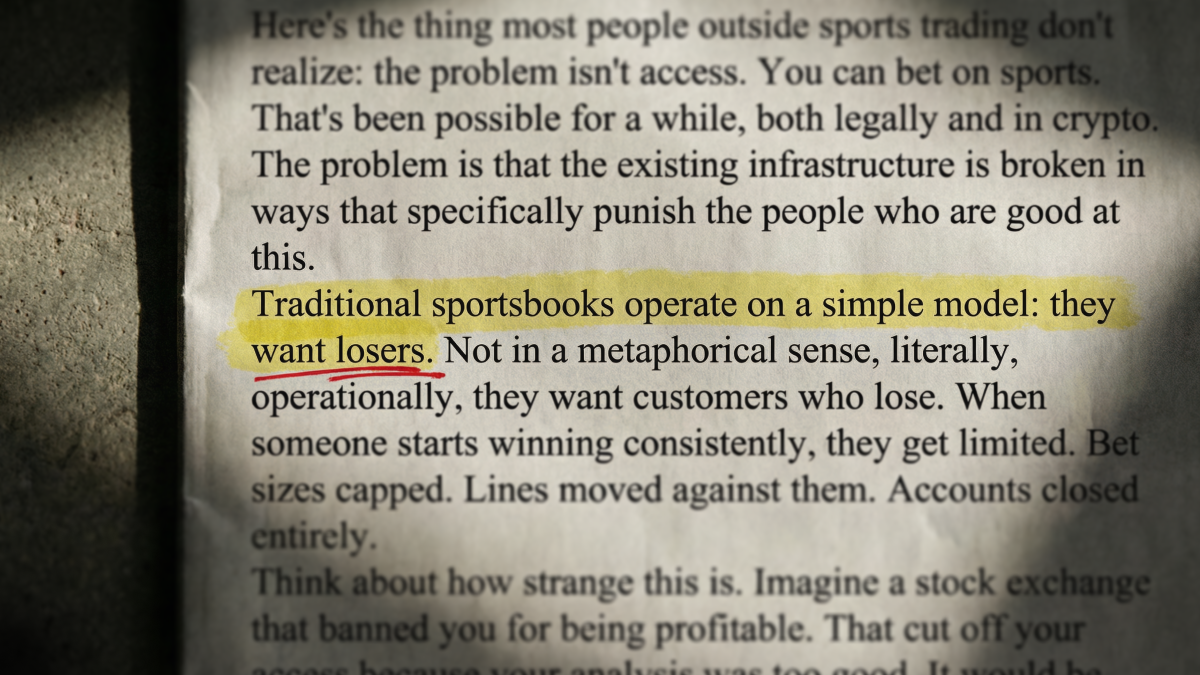
Here's the thing most people outside sports trading don't realize: the problem isn't access. You can bet on sports. That's been possible for a while, both legally and in crypto.
The problem is that the existing infrastructure is broken in ways that specifically punish the people who are good at this.
Traditional sportsbooks operate on a simple model: they want losers. Not in a metaphorical sense, literally, operationally, they want customers who lose. When someone starts winning consistently, they get limited. Bet sizes capped. Lines moved against them. Accounts closed entirely.
Think about how strange this is. Imagine a stock exchange that banned you for being profitable. That cut off your access because your analysis was too good. It would be absurd. But in sports betting, it's standard practice.
This creates a weird dynamic. The most sophisticated participants, the ones with the best models, the sharpest analysis, are systematically excluded from the market. They're forced into a game of cat and mouse, spreading action across dozens of accounts, using runners, constantly getting shut down.
Meanwhile, the recreational players get the full red carpet experience. Because they lose, which is the point.
Prediction markets like Polymarket don't have this problem because they're peer-to-peer. There's no house to beat. But general-purpose prediction markets don't have the sports-specific infrastructure that serious traders need: deep liquidity across thousands of markets, fast execution, live trading, the tools and data integration that this category demands.
So the gap isn't "can I bet on sports with crypto?" The gap is: can I trade sports outcomes with real liquidity, fair pricing, and infrastructure that doesn't actively work against me for being good?
What Purpose-Built Looks Like
When you design for sports specifically, different priorities emerge.
Exchange mechanics, not house odds. Peer-to-peer order books where price discovery happens through trading, not through a bookmaker setting lines and collecting margin. This changes everything. Spreads compress because you're trading against other participants, not against a house edge.
Speed that matters. In sports trading, lines move fast. Injury news, lineup changes, momentum shifts, information gets priced in quickly. Infrastructure needs to match that pace. Sub-second execution isn't a nice-to-have; it's table stakes.
Markets designed for the category. Not just match outcomes, but the full surface area of sports trading, spreads, totals, props, derivatives. The kind of market depth that serious traders expect.
Winners actually welcome. This sounds like marketing copy, but it's the foundational difference. An exchange model doesn't have a structural reason to ban profitable traders. Sharp money improves price discovery. It makes markets more efficient. It's a feature, not a bug.
None of this is theoretical. The mechanics exist. The infrastructure can be built. The question is whether it gets built by people who understand the category.
Where This Goes
We're not neutral observers here. We're building Pred because we think sports trading infrastructure should exist on-chain, and that it should be built specifically for the people who take this seriously.
Not because betting needs another app, it doesn't. But because there's a meaningful difference between a prediction market that includes sports and an exchange designed from the ground up for trading sports outcomes.
The Polymarket moment opened a window. It proved that prediction markets can achieve liquidity, cultural relevance, and real volume. It showed that people want to trade on the real world, not just on financial abstractions.
What comes next is specialization. Purpose-built infrastructure for categories that deserve it. Sports is the obvious one: massive volume, existing demand, structural problems to solve, and a community of skilled traders who've been waiting for something better.
That's what we're building. An exchange for sports outcomes. Trading infrastructure, not a sportsbook. A place where being good at this is an asset, not a liability.
The game is the game. We're just building better infrastructure to trade it.