
Betting odds explained: what the price means, and how often it was right across 7,980 Premier League matches
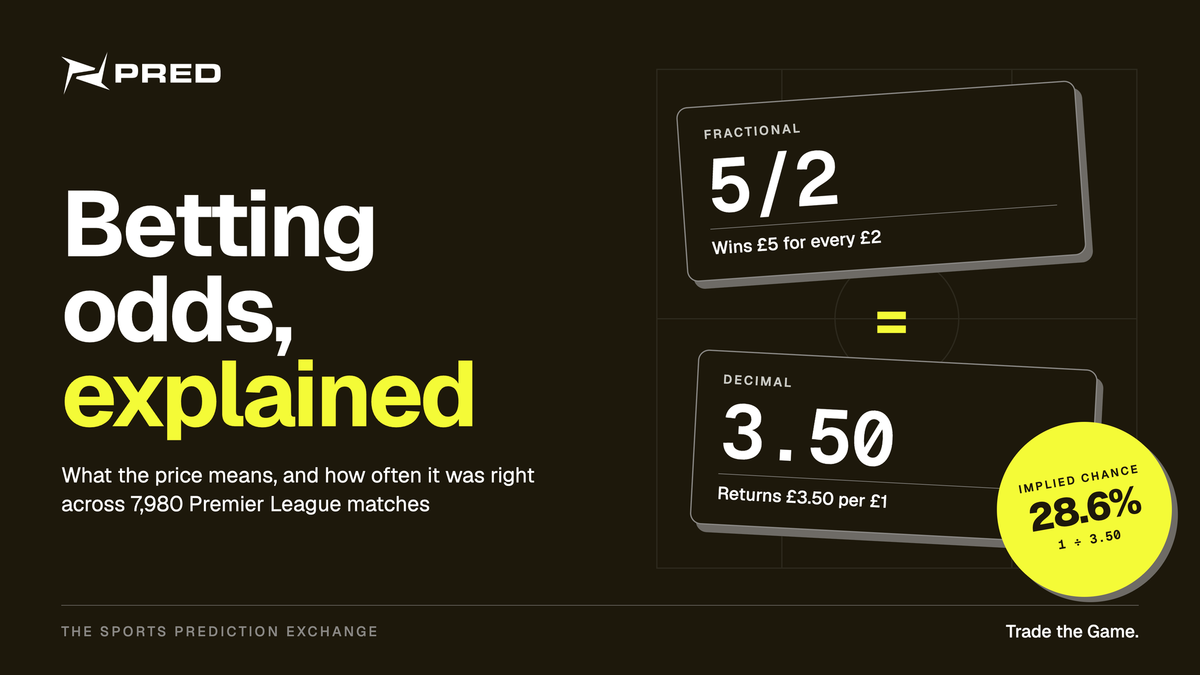
TL;DR: Betting odds tell you what a winning bet pays and the chance the bookmaker gives the outcome. Fractional 5/2, decimal 3.50 and American +250 are the same price, and each implies a 28.6% chance. Add up the chances across a match and they come to more than 100%. The excess is the bookmaker's margin: 5.6% on Bet365's Premier League match prices at kick-off in 2025/26. We checked 21 Premier League seasons, 7,980 matches, against the results. With the margin taken out and outcomes grouped by price, they happened within 0.7 percentage points of how often the prices said they would, on average. The clearest misses were the strong favourites, which won more often than their prices said. Outsiders cost the most to back.
How do betting odds work?
Betting odds are a price. They tell you what a winning bet pays for each pound you stake. From that you can work out the chance the bookmaker is putting on the outcome. UK bookmakers show the same price three ways.
Fractional odds give the profit against the stake. At 5/2 you win £5 for every £2 you stake and get the £2 back, so £10 returns £35.
Decimal odds give the whole return for each £1, stake included. At 3.50, £10 returns £35. Betting exchanges, most of Europe and the data in this piece use decimal.
American odds start from $100. A plus sign is the profit on a $100 stake, so +250 wins $250. A minus sign is what you stake to win $100, so −150 means risking $150.
All three convert to an implied probability: 1 divided by the decimal price. At 3.50 that is 28.6%.
Take the opening match of 2025/26, Liverpool against Bournemouth on 15 August 2025. At kick-off Bet365 had Liverpool at 1.29, the draw at 6.25 and Bournemouth at 9.00. Those prices imply 77.5%, 16.0% and 11.1%. Liverpool won 4-2.
What do 2/1, evens and odds-on mean?
2/1 means a winning bet makes twice its stake in profit. £10 at 2/1 returns £30, and the price implies a 33.3% chance. Evens is 1/1, or 2.00 in decimal: you double your money, at an implied 50%. Odds-on means shorter than evens, where the bookmaker makes the outcome more likely than not. At 1/2 you stake £2 to win £1, an implied 66.7%. Anything longer than evens is odds-against.
Fractional | Decimal | American | Implied probability | £10 returns |
|---|---|---|---|---|
1/2 | 1.50 | −200 | 66.7% | £15.00 |
4/6 | 1.67 | −150 | 60.0% | £16.67 |
10/11 | 1.91 | −110 | 52.4% | £19.09 |
Evens (1/1) | 2.00 | +100 | 50.0% | £20.00 |
6/4 | 2.50 | +150 | 40.0% | £25.00 |
2/1 | 3.00 | +200 | 33.3% | £30.00 |
5/2 | 3.50 | +250 | 28.6% | £35.00 |
3/1 | 4.00 | +300 | 25.0% | £40.00 |
5/1 | 6.00 | +500 | 16.7% | £60.00 |
10/1 | 11.00 | +1000 | 9.1% | £110.00 |
On a prediction exchange the implied probability is the price itself. A Yes contract at 40¢ on Pred is a 40% chance, the same as 6/4 or 2.50.
How do you convert odds to a percentage?
Divide 1 by the decimal price and multiply by 100. For the other formats, convert to decimal first:
- Fractional to decimal: divide the first number by the second and add 1. 5/2 is 2.5 plus 1, so 3.50.
- Fractional straight to a percentage: the second number divided by the sum of both. 5/2 is 2 ÷ 7, or 28.6%.
- Positive American to decimal: divide by 100 and add 1. +250 becomes 3.50.
- Negative American to decimal: divide 100 by the number without its sign and add 1. −150 becomes 1.67.
- Percentage back to decimal: divide 100 by the percentage. 25% becomes 4.00.
The converter below does all of it, in any direction. Its second panel checks a whole market: enter the prices for every outcome and it shows the margin and the chances with the margin removed.
Type a price in any format: 5/2, evens, 3.50, +250, −150, 28.6% or 29p. The second panel checks a whole market for its margin.
| Outcome | Price | Implied | Margin removed | Fair price |
|---|---|---|---|---|
| Home win | - | - | - | - |
| Draw | - | - | - | - |
| Away win | - | - | - | - |
What is the overround in betting?
The overround is the amount by which a market's implied probabilities add up to more than 100%. A match can only end one way, so a set of prices with no margin in it would add up to exactly 100%. Bookmakers price every outcome a little short, and the total comes out higher. The excess is the bookmaker's margin.
At Bet365's kick-off prices, Liverpool against Bournemouth adds up to 104.63%: 77.52% plus 16.00% plus 11.11%. On Betfair Exchange at kick-off, where customers set the prices, Liverpool were 1.32, the draw 6.80 and Bournemouth 10.00. Those add up to 100.46%. The exchange takes commission on winnings instead, 2% on its standard UK package.
To take the margin out, divide each implied probability by the total. Bet365's prices then give Liverpool 74.1%, the draw 15.3% and Bournemouth 10.6%. This proportional method cuts every outcome by the same proportion. Bookmakers load more of their margin onto some outcomes than others, as the next section shows.
Price source | Average margin at kick-off, 2024/25 | Average margin at kick-off, 2025/26 |
|---|---|---|
Bet365 | 5.55% | 5.59% |
William Hill | 5.24% (289 matches) | Not in the data |
Pinnacle | 2.99% | 2.95% (210 matches) |
Betfair Exchange, before commission | 0.56% | 0.56% (358 matches) |
Premier League match odds, 380 matches a season unless stated. Source: football-data.co.uk closing prices.
Bet365's margin at kick-off has sat between 5.39% and 5.59% in every season since 2019/20. Margins were much wider in the mid-2000s. In 2005/06 the market-average prices football-data recorded carried a 9.45% margin, and William Hill's carried 12.49%. By 2018/19 the market average was 4.19%. Football-data changed how it builds the average after that season, so later years don't compare directly. Accumulators and bet builders carry a larger margin again, because it compounds across every leg.
Where does the bookmaker's margin sit?
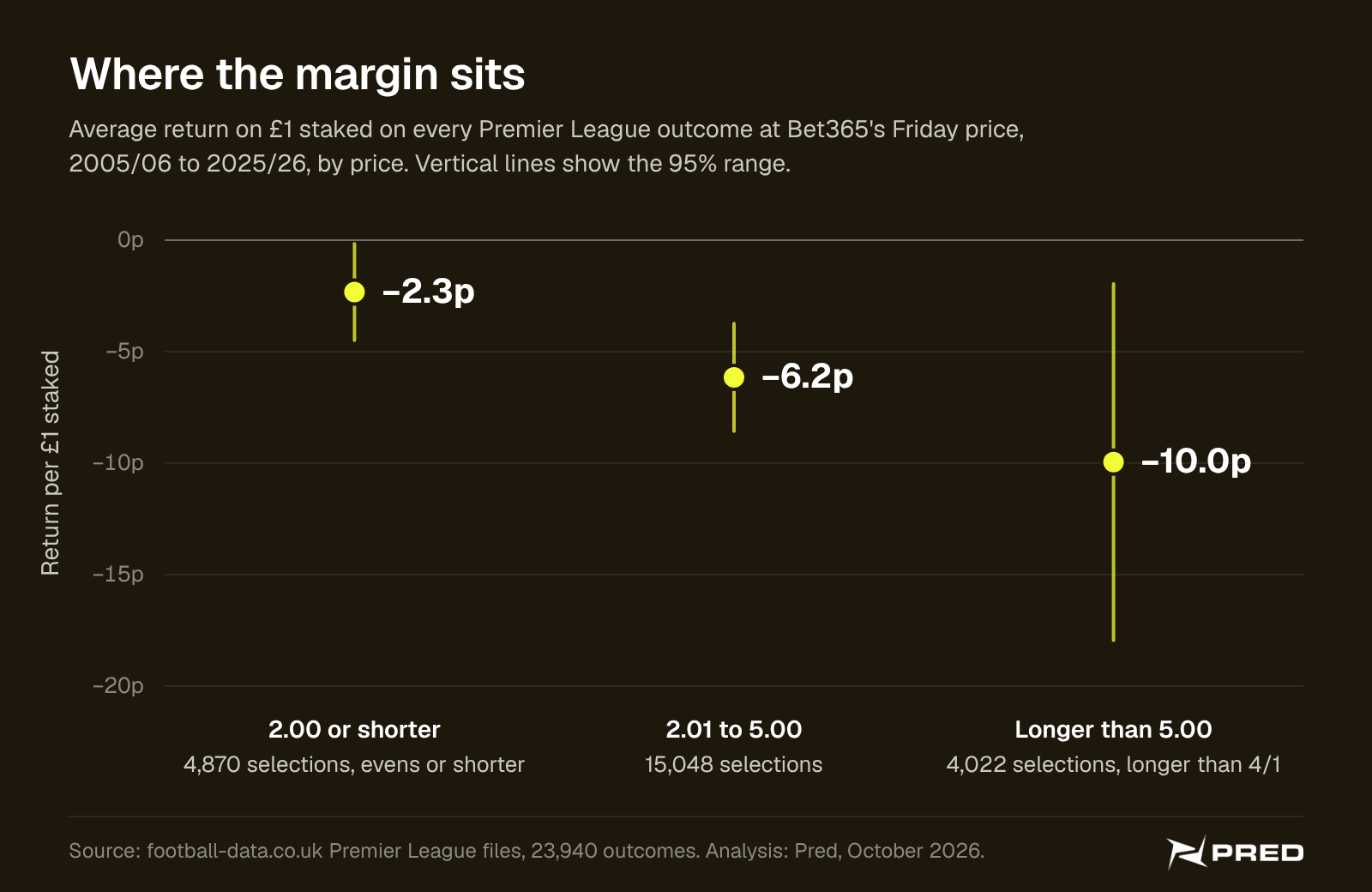
More of it sits on the outsiders. We backed every outcome of every Premier League match from 2005/06 to 2025/26 at Bet365's Friday price, £1 a time, and sorted the results by price.
Price | Selections | Winners | Return per £1 staked |
|---|---|---|---|
2.00 or shorter (evens or shorter) | 4,870 | 3,080 | −2.3p |
2.01 to 5.00 | 15,048 | 4,405 | −6.2p |
Longer than 5.00 (longer than 4/1) | 4,022 | 495 | −10.0p |
Every outcome | 23,940 | 7,980 | −6.0p |
On these figures, backing outsiders cost about four times as much as backing favourites. Each figure is an estimate, and the outsider row is the least precise. Only 495 of 4,022 outsiders won, so its 95% confidence range runs from 2.0p to 17.9p lost per £1, and this table alone can't separate it cleanly from the favourites' row. The pattern shows up more firmly in the accuracy table below, and in a much larger study by Tadgh Hegarty and Karl Whelan at University College Dublin, built on the same football-data.co.uk files. Across 84,230 matches in 22 European leagues, the least likely tenth of outcomes lost 17% of stake and the most likely tenth lost 2%. Their other findings are in our sports betting statistics.
This is where the proportional method goes wrong. It cuts every outcome's probability by the same proportion, while the bookmaker builds more of its margin into the outsiders. Strip the margin out proportionally and outsiders still look a little more likely than they are, and favourites a little less.
How accurate are betting odds?
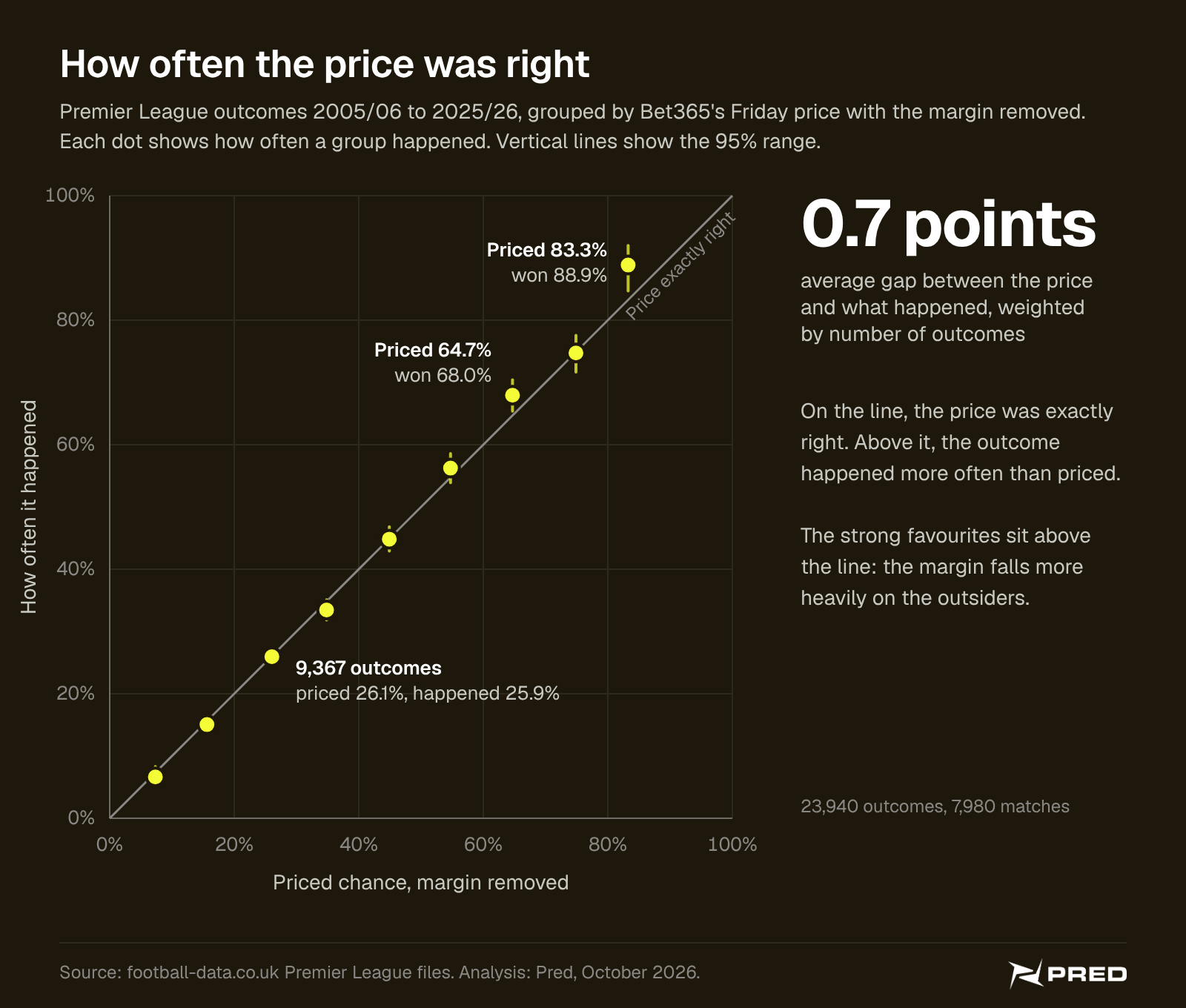
Accurate across a large number of matches, and least accurate for strong favourites. We took Bet365's Friday prices for all 7,980 Premier League matches from 2005/06 to 2025/26 and removed the margin with the proportional method. We then grouped the 23,940 outcomes by the chance their price gave them and counted how often each group happened.
Priced chance, margin removed | Outcomes | Average priced chance | How often it happened |
|---|---|---|---|
Under 10% | 1,067 | 7.3% | 6.7% |
10% to 20% | 3,653 | 15.6% | 15.1% |
20% to 30% | 9,367 | 26.1% | 25.9% |
30% to 40% | 3,205 | 34.8% | 33.4% |
40% to 50% | 2,482 | 44.9% | 44.8% |
50% to 60% | 1,737 | 54.7% | 56.2% |
60% to 70% | 1,311 | 64.7% | 68.0% |
70% to 80% | 831 | 74.9% | 74.7% |
80% and over | 287 | 83.3% | 88.9% |
In seven of the nine bands, outcomes happened within 1.6 percentage points of the price. Weighted by the number of outcomes, the gap averaged 0.7 points. The two bands that missed hold the strong favourites. Teams priced at 60% to 70% won 68.0% of the time against 64.7% priced. Those priced at 80% or more won 88.9% against 83.3%. Both fall outside their 95% intervals, and both are the other side of the outsider pattern above: the proportional method leaves favourites with too little of the probability.
Other price sources tell the same story. Pinnacle's kick-off prices from 2012/13 to 2024/25 missed by 0.8 points on average across 14,820 outcomes in 4,940 matches. The market-average kick-off price from 2019/20 to 2025/26 missed by 0.5 points across 7,980 outcomes in 2,660 matches. Betfair Exchange prices only appear in the data from 2024/25, which leaves too few outcomes to measure the exchange's accuracy against the bookmakers'.
The headline results line up too. Across the 21 seasons, the shorter-priced side won 54.9% of the 7,922 matches that had a favourite, against 53.8% priced. Draws were priced at 24.8% on average and happened in 24.3% of matches. Home wins were priced at 44.6% and happened in 45.6%.
Single seasons swing further. In 2020/21, played almost entirely without crowds, home teams won 37.9% of matches and away teams 40.3%. No other season of the 21 had more away wins than home wins. Bet365's Friday prices had cut the home side's chance to 42.0%, from 44.7% in the other 20 seasons, which covered part of the fall. In 2025/26 there were 104 draws in 380 matches, 27.4%, the most since 2015/16, against 24.4% priced. The favourite won 49.2% of the time against 52.3% priced, its worst season since Leicester's title in 2015/16.
A price is a forecast for one match. Across thousands of matches it lands close to the truth. Inside a single season it can miss by several points.
How do prices work on a prediction exchange?
A prediction exchange quotes each outcome as a Yes contract that pays $1 if it happens and nothing if it doesn't. The price runs from 1¢ to 99¢ and reads straight as a probability, which Pred's documentation sums up as "prices = probabilities". Traders set the price by posting orders on an order book. Pred runs the venue and never takes a side.
Two things follow. There is no margin to strip out first, because nobody builds one in. Pred lists a match's home win, draw and away win as separate markets, and exactly one of them settles Yes. The three Yes prices should therefore add up to $1. The cost of trading sits outside the price, in two places: the spread between the best bid and the best offer, and a fee on the side that takes the price. Pred's fee schedule sets that fee at 0.025 × contracts × price × (1 − price). Per contract it peaks at 50¢, where it comes to 1.25% of what you spend, and falls towards both ends of the range. As a share of spend it runs from 2.25% at 10¢ to 0.25% at 90¢. An order that rests on the book until another trader fills it pays nothing.
Converting a bookmaker price into a Yes price is the same division as before: 1 ÷ decimal odds. Bet365's 6.25 for the draw at Anfield works out as 16.0¢, and Betfair Exchange's 6.80 as 14.7¢. About half of that gap is margin. With both margins removed, Bet365 still had the draw at 15.3%, against 14.6% on the exchange. The lay bet guide does the same sum for the No side.
Orders on Pred match in 200ms, and markets resolve within three to four minutes of the result being confirmed. Deposits work in fiat as well as crypto.
Trading carries risk. A position can settle at a total loss, and none of the figures above is a forecast of returns.
Common questions
How do betting odds work?
Betting odds tell you what a winning bet pays and the chance the bookmaker gives the outcome. Fractional odds show profit against stake, so 5/2 wins £5 for every £2. Decimal odds show the whole return per £1, so 3.50 returns £3.50. Divide 1 by the decimal price for the implied probability: 3.50 implies 28.6%.
What does 2/1 mean in betting?
2/1, said two-to-one, means a winning bet makes twice its stake in profit. A £10 bet at 2/1 returns £30: £20 profit plus the £10 stake. In decimal it is 3.00 and in American odds +200. The price implies a 33.3% chance that the outcome happens.
What does evens mean in betting?
Evens is 1/1: a winning bet makes the same in profit as its stake, so £10 returns £20. In decimal odds evens is 2.00, and in American odds +100. It implies a 50% chance. Prices shorter than evens are odds-on, and longer ones are odds-against.
What does odds-on mean?
Odds-on means a price shorter than evens, so the bookmaker rates the outcome as more likely than not. At 1/2 you stake £2 to win £1, and the price implies a 66.7% chance. Every odds-on price is below 2.00 in decimal, and carries a minus sign in American odds.
How do you convert odds to a percentage?
Divide 1 by the decimal price and multiply by 100, so 4.00 is 25%. For fractional odds, divide the second number by the sum of both: 5/2 is 2 ÷ 7, or 28.6%. These are implied probabilities with the bookmaker's margin still in, so a market's percentages add up to more than 100%.
What is the overround?
The overround is how far a market's implied probabilities add up beyond 100%, and the excess is the bookmaker's margin. Bet365's Premier League match prices carried an average margin of 5.59% at kick-off in 2025/26. Betfair Exchange prices averaged 0.56%, before the exchange's commission on winnings.
Are betting odds accurate?
Across many matches, yes. We took 21 Premier League seasons of Bet365 prices, removed the margin and grouped outcomes by price. Results landed within 0.7 percentage points of the priced chance on average. Strong favourites won more often than priced: teams priced at 80% or more won 88.9% of the time.
Method and sources
Every result and price in this piece comes from football-data.co.uk's Premier League files for 2005/06 to 2025/26, retrieved on 18 October 2026. The files are compiled by Joseph Buchdahl from bookmakers, Betbrain and Oddsportal, and the UCD study cited above uses the same source. We did the arithmetic ourselves. No figure comes from a betting site, a comparison site or a review.
- Friday prices are football-data's pre-closing odds, collected on Friday afternoons for weekend matches and Tuesday afternoons for midweek ones. Kick-off prices are its closing odds. Bet365's Friday prices cover all 7,980 matches. Kick-off prices start in 2019/20 for Bet365, 2012/13 for Pinnacle and 2024/25 for Betfair Exchange.
- Margin is the sum of 1 ÷ decimal price across home win, draw and away win, minus 1, averaged across matches. Betfair Exchange figures are before commission.
- The margin is removed proportionally: each implied probability is divided by the market's total.
- For accuracy, outcomes are grouped into nine bands by their margin-free chance, each band including its lower edge. Each band compares the average priced chance with the share of outcomes that happened, with 95% intervals by the Wilson method. The 0.7-point figure is each band's absolute gap, weighted by its number of outcomes.
- Returns assume £1 on every outcome at Bet365's Friday price. A winner returns its price minus 1 and a loser returns −1. The 95% intervals come from the standard error of the mean.
- The favourite is the side with the shorter Friday price. The 58 matches with level prices are left out.
- Football-data's market averages come from Betbrain until 2018/19 and from a different set of bookmakers after that, and the bookmakers inside the average change between seasons. We do not compare market averages across that switch.
Sources:
- football-data.co.uk, Premier League results and odds files, 2005/06 to 2025/26, and the field definitions in its notes file
- Hegarty, T. and Whelan, K. (2023), Calculating The Bookmaker's Margin: Why Bets Lose More On Average Than You Are Warned, University College Dublin, MPRA Paper 116924
- HM Revenue & Customs, Gambling duty changes, 26 November 2025
- Pred documentation: How prices are calculated, Order book, Fees
Figures verified 18 October 2026. We will rerun them after each season. From 1 April 2027 online bets on football move from 15% to a 25% rate of general betting duty, and HMRC's impact note says customers will feel it if operators pass the rise on through the odds. The 2027/28 numbers will show whether it does.