
Matched betting explained: how a free bet becomes cash, and what the bookmaker does next
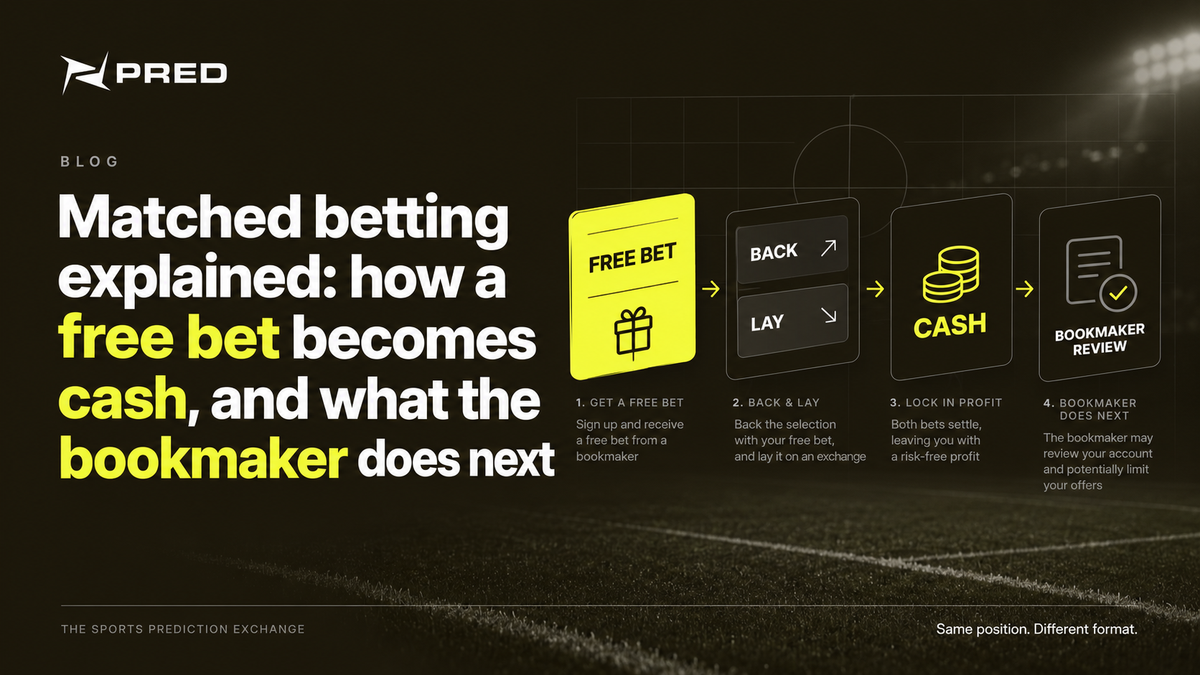
TL;DR: Matched betting turns a bookmaker's free bet into cash you can withdraw. You back a selection with the bookmaker and lay it on an exchange, so the two bets cancel out whatever the result. A £10 free bet backed at 6.0 and laid at 6.2 on a 2% exchange locks in £7.93. It is legal in the UK, and HMRC does not tax betting winnings. The limits sit in the bookmaker's terms, which let it reclaim a bonus used to guarantee a profit and stop offering you promotions. You can lay on any exchange, or buy No on a Yes/No exchange such as Pred, where a resting order pays no fee.
How does matched betting work?
Matched betting uses two bets on the same selection. You back it with a bookmaker, which pays if it wins, and you lay it on an exchange, which pays if it doesn't. Get the lay stake right and the two cancel out, leaving you with the value of the bookmaker's offer.
A sign-up offer comes in two parts. The qualifying bet is your own money, staked to trigger the offer, and matching it locks in a small loss: 45p in the example below. The free bet is the bookmaker's money. A stake-not-returned (SNR) free bet pays the winnings without the stake, so £10 at 6.0 pays £50, not £60.
The lay stake depends on which of the two you are matching. Commission goes in as a decimal, so 2% is 0.02.
Qualifying bet: lay stake = back stake × back odds ÷ (lay odds − commission)
Free bet (SNR): lay stake = free bet × (back odds − 1) ÷ (lay odds − commission)
A winning qualifying bet hands your stake back, so the first formula counts it. An SNR free bet keeps its stake, which is why the second uses the back odds minus one.
A worked example: bet £10, get a £10 free bet
Take a £10 qualifying bet at 3.00 that earns a £10 SNR free bet. Both lays go on an exchange charging 2% of net market winnings, the Standard Tier rate at Smarkets.
The qualifying bet: back £10 at 3.00, lay £9.74 at 3.10.
Selection wins | Selection doesn't win | |
|---|---|---|
Bookmaker | +£20.00 | −£10.00 |
Exchange lay | −£20.45 | +£9.55 |
Net | −£0.45 | −£0.45 |
The free bet: back the £10 SNR free bet at 6.00, lay £8.09 at 6.20.
Selection wins | Selection doesn't win | |
|---|---|---|
Bookmaker | +£50.00 | £0.00 |
Exchange lay | −£42.07 | +£7.93 |
Net | +£7.93 | +£7.93 |
The offer is worth £7.48 whatever the score: £7.93 from the free bet, less the 45p the qualifying bet cost. Watch the liability on the free bet lay. It ties up £42.07 of your exchange balance until the match settles, so the money has to be there before you place it.
How much of a free bet do you keep?
The longer the back odds, the more of the free bet you keep. At 2.0, half of what a winning bet returns is stake, and an SNR free bet never pays the stake. At 10.0 the stake is a tenth of the return, so far less of the free bet's value goes missing.
The table holds the lay price equal to the back price, to isolate the effect of the odds. Figures are per £10 SNR free bet.
Back odds | Kept on a 2% exchange | Kept on Pred, resting No order |
|---|---|---|
2.0 | £4.95 | £5.00 |
3.0 | £6.58 | £6.67 |
4.0 | £7.39 | £7.50 |
6.0 | £8.19 | £8.33 |
10.0 | £8.84 | £9.00 |
In practice the lay price sits above the back price, and each tick between them comes off what you keep. That gap is why the worked example, backed at 6.0 and laid at 6.2, returns £7.93 and not £8.19.
Is matched betting legal?
Yes. Backing a selection with a bookmaker and laying it on an exchange breaks no UK law. The rules that bind you are the bookmaker's terms, which you accept when you claim the offer.
Those terms give the bookmaker room to act. Paddy Power's are quoted in a 2016 Advertising Standards Authority ruling. They let it reclaim the bonus and void the offer where it sees evidence that a customer is using it "to guarantee profits regardless of the outcome". Paddy Power told the ASA it barred under 0.5% of its customers from promotions over the risk of bonus abuse.
The Gambling Commission leaves this to operators. Its chief executive wrote in July 2025 that how operators manage their commercial liabilities is outside its remit. The same post notes that being a successful bettor is not a protected characteristic in discrimination law.
Do you pay tax on matched betting?
Not as an individual. HMRC's Business Income Manual states that betting, as such, is not trading (BIM22015). Having a system, or earning a living from betting, does not make it a trade either (BIM22017). Both pages rest on Graham v Green, a 1925 case about a man who lived on his winnings from backing horses.
HMRC's exception is an organised activity that makes its profit from the betting public, which it treats as trading. That describes the bookmaker's side of the counter, not yours. This is a summary of HMRC's guidance, not tax advice.
What changed for matched betting in January 2026?
Two Gambling Commission rules came into force on 19 January 2026, through a rewrite of Social Responsibility Code 5.1.1. The Commission announced them in March 2025 and pushed the start date back a month in July.
The first bans promotions that mix product types. The Commission's guidance for operators gives examples: bet £5 for 20 free spins fails, and so does a £5 free bet bundled with spins, while bet £5 for a £10 free bet passes.
The second caps wagering requirements on bonus funds at ten times. Under the old rules, the Commission's own example of a £10 bonus at 50 times meant re-staking £500 before you could withdraw. The cap brings that down to £100.
For matched bettors, the change is in the shape of the offers. A football sign-up offer can no longer arrive bundled with casino spins, and any bonus that needs re-staking needs it ten times at most.
Why does matched betting end in a restricted account?
Matched bettors call it getting gubbed: the bookmaker excludes the account from promotions, cuts its maximum stake or closes it. Paddy Power described the first of these to the ASA in 2016. Customers it judged a bonus-abuse risk received an email telling them they would no longer be offered promotions, bonuses or enhanced prices.
The Gambling Commission's 2025 data request to some of the largest online betting operators found 643,779 of 14,923,840 active accounts under a commercial restriction, or 4.31%. Restricted customers were nearly twice as likely to be in profit: 46.78%, against 25.42% of all active customers. The data does not break restrictions down by reason, so it cannot say how many of those accounts belonged to matched bettors.
Exchanges work on a different model. An exchange matches you with another customer instead of taking your bet itself, so when you win, the money comes from that customer and not from the exchange. Our guide to restricted betting accounts sets out each kind of restriction and how to spot it.
Can you lay a bet on a prediction exchange?
Yes. On a Yes/No exchange the lay is called buying No. Pred's football fixtures carry separate markets for the home side, the draw and the away side. A No contract on any of them pays $1 if that outcome does not happen. The football example in Pred's docs settles on 90 minutes plus stoppage time, so check that your bookmaker's market settles the same way.
Sizing a No position is simpler than sizing a lay. Buy as many No contracts as the bookmaker would pay you if the selection won: the full return on a qualifying bet, the winnings alone on an SNR free bet. The No price only sets what the position costs.
Run the same offer through Pred at No prices of 68p and 84p. Those are the equivalent of laying at 3.125 and 6.25, a shade worse for you than the 3.10 and 6.20 in the exchange example.
No contracts | No price | Cost | Net, either result | |
|---|---|---|---|---|
Qualifying bet, £10 at 3.00 | 30 | 68p | £20.40 | −£0.40 |
SNR free bet, £10 at 6.00 | 50 | 84p | £42.00 | +£8.00 |
That is £7.60 for the offer, 12p more than the exchange example despite the worse prices. Pred contracts pay $1 in USDC, so convert the bookmaker figure at your deposit rate when you size the order. The examples stay in pounds to keep them comparable.
Those figures assume your No orders rest on the book until another trader fills them, which makes you the maker. Pred's fee schedule charges makers nothing, and charges nothing to place, amend or cancel an order. Buy at a price already on the book and you pay the taker fee instead: 0.025 × contracts × price × (1 − price). On these two orders it comes to 33p, which takes the offer to £7.27. Pred takes the fee in contracts, so buy a fraction more than you need to hold the full amount.
Resting orders suit matched betting for a second reason. Post the No order first, at the price that makes the offer work, and place the bookmaker bet once it fills. Keep that gap short, because one side stays open until both are placed. If the bookmaker's price moves before your order fills, cancel it and reprice.
Read the postponement rules on both sides before you lay a fixture under threat. Each Pred market states its resolution rules up front, and the football example in its docs keeps a postponed match's market open until the game is played. It resolves No if the game is cancelled with no rearranged date. If your bookmaker voids the bet instead, your No position is no longer hedged.
Markets resolve within three to four minutes of the result being confirmed, so the money from one offer is back in your balance for the next. Pred runs the venue and never takes a side, so a profitable account costs it nothing and it has no commercial reason to restrict one. Deposits work in fiat as well as crypto.
Trading carries risk. A position can settle at a total loss, and none of the figures above is a forecast of returns.
Common questions
Is matched betting legal in the UK?
Yes. Backing a selection with a bookmaker and laying it on an exchange breaks no UK law. The limits are contractual: bookmakers' promotion terms let them reclaim a bonus they believe was used to guarantee a profit, and stop offering promotions to that account. The Gambling Commission treats how operators manage commercial liabilities as outside its remit.
Do you pay tax on matched betting?
Not as an individual. HMRC's Business Income Manual says betting, as such, is not trading (BIM22015). A system, or a living made from it, does not turn it into a trade (BIM22017). HMRC treats an organised activity that profits from the betting public as trading, which is the bookmaker's position and not the customer's.
How much can you make from matched betting?
Most of each free bet's face value. Laid at its own back price on a 2% exchange, a £10 stake-not-returned free bet keeps £4.95 at 2.0, £8.19 at 6.0 and £8.84 at 10.0. The qualifying bet costs a little: 45p in our worked example. Over time, what you make depends on how many offers your accounts can still claim.
Is matched betting risk-free?
No. The arithmetic removes the match result, but a bookmaker can still reclaim a bonus under its terms. A lay or a No order that has not filled leaves one side open, and venues apply different rules when a match is postponed. A wrong stake calculation exposes you as well.
Can you matched bet without Betfair?
Yes. Any exchange with a lay side works, including the Betfair alternatives we compared, and Smarkets charges 2% of net market winnings on its Standard Tier. On a Yes/No exchange such as Pred you buy No instead, holding as many No contracts as the bookmaker would pay out. A resting order on Pred pays no fee.
Does matched betting still work in 2026?
Yes. Since 19 January 2026, Gambling Commission rules have banned promotions that mix betting with casino products and capped wagering requirements on bonus funds at ten times. A plain offer such as bet £5, get a £10 free bet is compliant under the new rules. Bookmakers can still exclude any account from promotions under their own terms.