
Accumulator bets explained: what an acca pays, and what it cost across 21 Premier League seasons
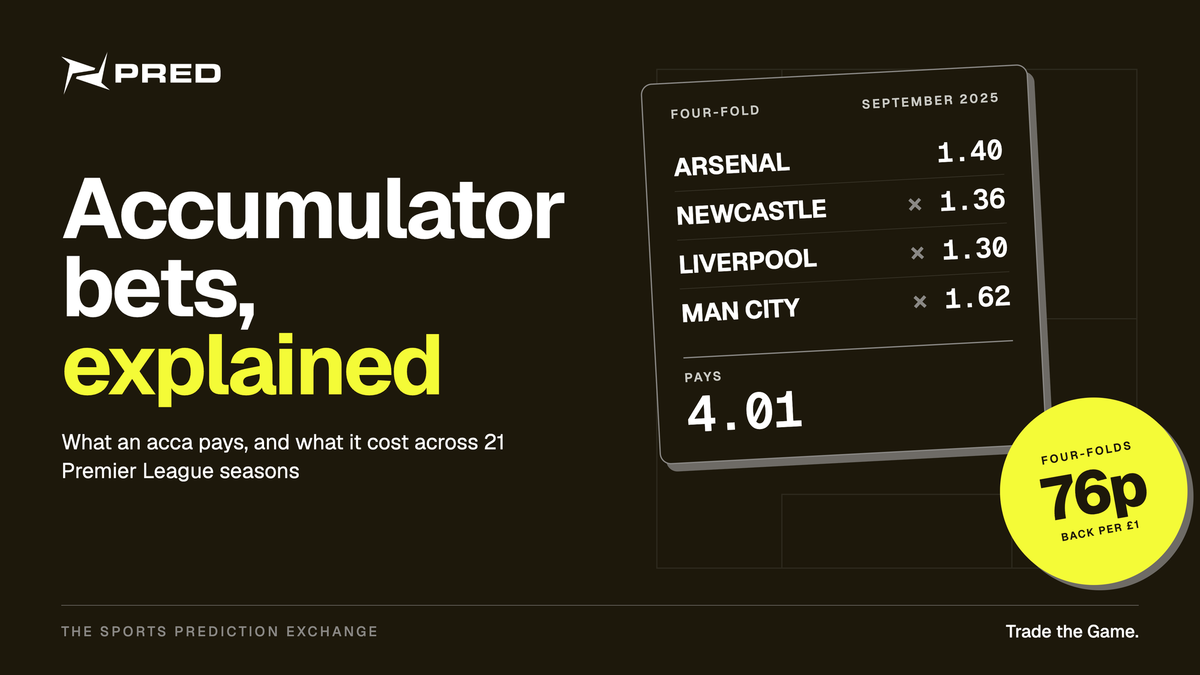
TL;DR: An accumulator, or acca, joins selections from different matches into one bet. Every leg has to win, and the prices multiply: £10 on Arsenal, Newcastle, Liverpool and Manchester City one weekend in September 2025 returned £40.10. The bookmaker's margin multiplies too. We built every acca of two to eight legs that the weekend's Premier League favourites allowed, at Bet365's kick-off prices from 2019/20 to 2025/26. As singles, the favourites returned 95.4p for every £1 staked. As four-folds they returned 76.3p, and as eight-folds 42.3p. Over 21 seasons, the weekend's five shortest-priced favourites all won on one weekend in nine.
An accumulator turns short prices into a long one. That September weekend, four favourites priced between 3/10 and 8/13 made a 3/1 shot together. Each of those prices carried the bookmaker's margin, and the acca multiplied the margin along with the prices.
This guide covers what an acca pays, what it costs you, and what happened when we ran 21 seasons of Premier League favourites through accas. The calculator below does the sums for your own selections.
What is an accumulator bet?
An accumulator is one bet on two or more selections from different events, and every selection has to win for it to pay. Paddy Power's help centre puts it in a line: "you have two or more selections and you need them all to win to get a return." Each selection is a leg.
Two legs make a double, three a treble and four a four-fold, and the folds carry on from there. Some betting guides keep the word for four legs or more. Each leg's winnings ride on the next leg, so the return accumulates.
A bet builder is a different product. Its legs come from the same match, so they depend on each other. A home win and over 2.5 goals in one game tend to arrive together, so the bookmaker can't multiply the two prices. It quotes its own price for the pair instead.
How do you work out what an acca pays?
Multiply the decimal prices of every leg, then multiply by your stake. The answer is your return, with the stake included. Here is a four-fold of favourites from the weekend of 13 and 14 September 2025, at Bet365's prices at kick-off.
Leg | Kick-off | Bet365 price | Result |
|---|---|---|---|
Arsenal to beat Nottingham Forest | Sat 12:30 | 1.40 (2/5) | Won 3-0 |
Newcastle to beat Wolves | Sat 15:00 | 1.36 (4/11) | Won 1-0 |
Liverpool to win at Burnley | Sun 14:00 | 1.30 (3/10) | Won 1-0 |
Manchester City to beat Manchester United | Sun 16:30 | 1.62 (8/13) | Won 3-0 |
1.40 × 1.36 × 1.30 × 1.62 = 4.01. A £10 four-fold returned £40.10, of which £30.10 was profit. With fractional prices, add 1 to each fraction first, so 2/5 becomes 1.40. The odds guide covers the conversions.
The acca's price also gives the bookmaker's view of how likely it is. 1 ÷ 4.01 is 24.9%, about one in four. That figure still has the margin in it, which the next section takes apart.
Enter each leg's price in any format: 2/5, evens, 1.40, +250, 71% or 71p. Add the other prices in that leg's market and the calculator also shows the fair price and what the margin costs you.
Add the other prices in each open leg's market, for example 4.75, 7.50, to see the fair price.
Fair chances scale each market's prices down in proportion until they add up to 100%. Favourites carry less than a proportional share of the margin, so on an acca of favourites the true cost is lower than shown. "Back per £1" is the average over many accas like this one, not a forecast for this one.
Add the other prices in each open leg's market to value insurance and boosts.
Enter each leg's price for the return. Add the other prices from each leg's market and it also shows the fair price, what the margin costs and what insurance or a boost is worth. It works from the prices you enter, so its figures for your acca will differ from the averages below.
Why does the margin grow with every leg?
Every price carries the bookmaker's margin. Add up the implied chances of a match's three outcomes and the total comes to more than 100%; the excess is the margin. Bet365's kick-off prices for Arsenal against Forest add up to 105.8%: 71.4% for Arsenal, 21.1% for the draw and 13.3% for Forest.
An acca multiplies the margin across matches. Four matches with three outcomes each give 81 possible four-folds, from all four favourites to all four outsiders. Multiply out each one's implied chance and the 81 add up to 125.2%. The four matches' prices added up to 105.8%, 105.3%, 105.4% and 106.6%, and 1.058 × 1.053 × 1.054 × 1.066 = 1.252.
Each match carried between 5.3% and 6.6% of margin. The four-fold carries 25.2%. A bookmaker that took bets on all 81 in proportion to their chances would keep about 20p of every £1.
Scale each market's chances down in proportion until they add up to 100%, and the four-fold's fair price comes to 5.02. Bet365's acca paid 20% less than that, the figure the calculator above shows. Favourites carry less than a proportional share of the margin, though. Betfair Exchange, where customers set the prices, had the four favourites at 1.45, 1.39, 1.34 and 1.70 at kick-off. Each of its four markets carried less than 1% of margin. On those prices the fair price is 4.71, and Bet365's acca paid 15% less.
If each leg pays a share m less than it should, an acca of n legs keeps (1 − m) multiplied by itself n times. At 5% a leg, a double keeps 90.3% of its value, a four-fold 81.5% and an eight-fold 66.3%.
Are accumulator bets worth it?
At today's prices, no. We built accas from Premier League favourites at Bet365's kick-off prices since 2019/20. Every size returned less per £1 than the same favourites as singles, and the gap grew with each leg.
We took every Premier League weekend from 2019/20 to 2025/26, Friday to Monday, and the favourite in each match. Then we built every possible acca from those favourites, from every double up to every eight-fold. That came to 197,108 accas over 232 weekends, each priced at Bet365's kick-off prices and settled on the result.
Legs | Accas built | Landed | Chance in the prices | Returned per £1 |
|---|---|---|---|---|
1 (singles) | 2,187 | 54.3% | 56.8% | 95.4p |
2 | 9,419 | 28.9% | 32.2% | 89.9p |
3 | 24,333 | 15.1% | 18.3% | 82.9p |
4 | 41,590 | 7.7% | 10.3% | 76.3p |
5 | 49,091 | 3.9% | 5.8% | 69.8p |
6 | 40,554 | 2.0% | 3.3% | 61.4p |
7 | 23,223 | 1.1% | 1.9% | 48.8p |
8 | 8,898 | 0.7% | 1.0% | 42.3p |
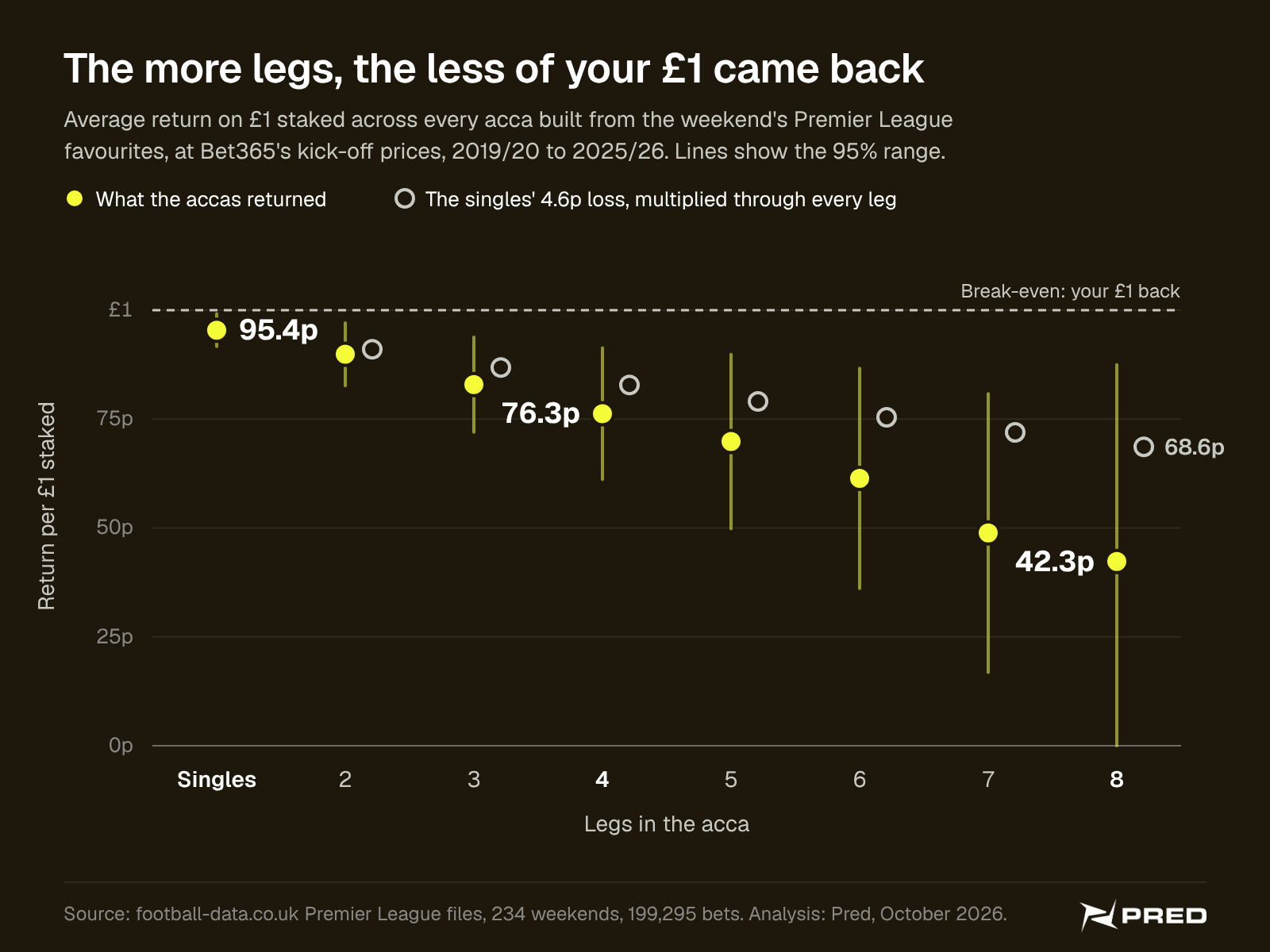
The multiplication explains most of it. As singles, the favourites lost 4.6p per £1. Multiply that loss through and a four-fold should return 82.8p, and an eight-fold 68.6p. The real accas did worse, at 76.3p and 42.3p. Accas are lumpy, so the range around each figure is wide. For the four-fold, anything from 61p to 91p fits the data, and the 82.8p prediction sits inside it.
Over all 21 seasons at Bet365's Friday prices, the pattern points the same way with less to lose on each leg. Singles returned 97.2p, doubles 95.8p, trebles 94.1p, four-folds 93.3p and five-folds 91.9p. Past five legs, the 21-season results swing too much from one weekend to the next to separate the cost from luck.
The operators say the same in their results. Flutter owns Sky Bet and Paddy Power. In February 2026 it told investors that FanDuel, its US sportsbook, ran a structural revenue margin of 15.5% in the last quarter of 2025. That was 0.9 points up on a year earlier. Flutter said the rise was "driven by continued increase in parlay penetration", and parlay is the American word for an acca. The guide to how bookmakers set odds has the rest of those numbers.
How often does an acca land?
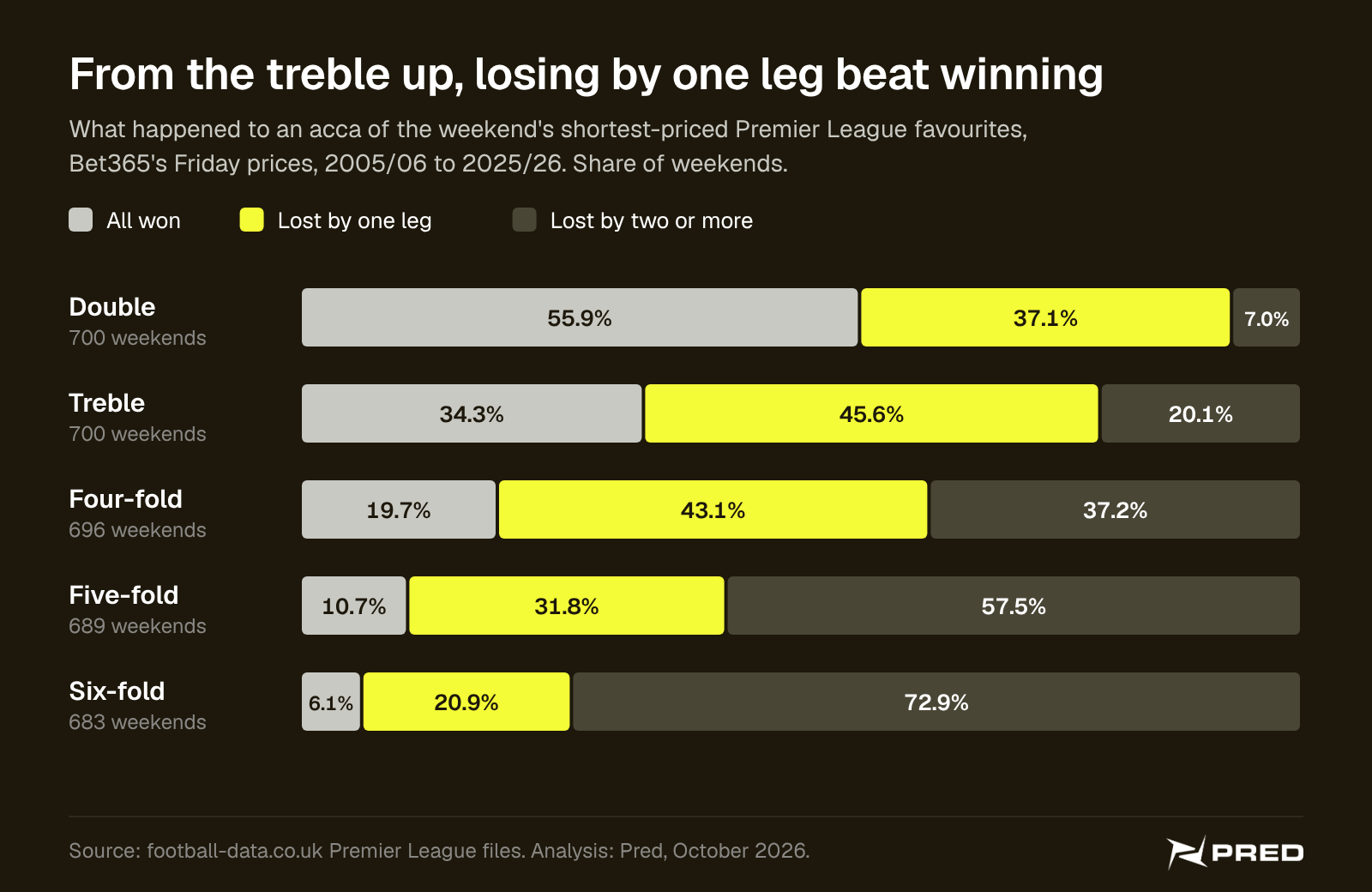
Less often than the prices say. Take the weekend's shortest-priced favourites, the bankers most accas are built on. Over 21 Premier League seasons at Bet365's Friday prices, this is how often all of them won.
Shortest favourites in the acca | Weekends | All won | Chance in the prices |
|---|---|---|---|
2 | 700 | 55.9% | 56.8% |
3 | 700 | 34.3% | 37.2% |
4 | 696 | 19.7%, about 1 in 5 | 22.5% |
5 | 689 | 10.7%, about 1 in 9 | 12.7% |
6 | 683 | 6.1%, about 1 in 16 | 6.7% |
8 | 655 | 3 weekends | 1.6% |
10 | 547 | 1 weekend | 0.3% |
From the double up, every size landed less often than its prices implied. The eight-fold's prices gave it a 1.6% chance. It landed on 3 of 655 weekends, 0.5%: in February 2007, January 2014 and May 2017.
From the treble up, losing by one leg was more common than winning. The weekend's five shortest favourites lost by exactly one leg on 219 of 689 weekends, 31.8%, three times as often as all five won.
Do acca insurance and acca boosts change the maths?
Cash insurance can cancel the margin on a small stake. A boost covers only part of it, except on accas so long they rarely land.
Acca insurance refunds your stake when exactly one leg lets the acca down. Betfred's Acca Flex covers football accas of five or more legs, each priced 1/2 or longer, placed before or during the match. It pays back up to £10 in cash, once a day. Spreadex runs a version by email for named customers, refunding up to £25 as a free bet on a five-fold or bigger.
Our data puts a value on the cash version. Take five-folds of the weekend's shortest favourites priced 1/2 or longer. At Friday prices across 21 seasons, exactly one leg lost on 124 of 674 weekends, 18.4%. At kick-off prices since 2019/20 it was 44 of 223, 19.7%. A cash refund on those weekends is worth 18p to 20p per £1 staked, while the stake stays within the cap.
The margin on that kind of five-fold costs a little less. Multiply the singles' loss on those legs through five legs and it comes to 12.7p per £1 at Friday prices and 16.5p at kick-off prices.
Three things eat into the refund. The cap: a £50 five-fold still gets £10 back, a fifth of the value. A free bet is worth less than cash, because when it wins you keep the winnings, not the free stake. And bookmakers limit accounts that only take offers, which our gubbing guide covers.
A boost adds a percentage to the winnings when the acca lands. Here is the boost each size of acca needs to break even, with the kick-off loss on those legs multiplied through, against what Betfred adds.
Legs | Boost needed to break even | Betfred's Acca Flex |
|---|---|---|
5 | about 21% | 5% |
8 | about 34% | 20% |
12 | about 54% | 50% |
20 | about 105% | 100% |
On the lower margins in the older Friday prices, the twelve- and twenty-fold boosts would clear break-even. Accas that long rarely land, though: the weekend's eight shortest favourites all won on 3 of 655 weekends.
What happens if a leg is void?
A void leg drops out and the acca settles on the legs left, so a four-fold with one void leg pays as a treble. Betfred's offer terms show the mechanism when they exclude accas left with fewer legs "due to abandonment, postponement or voided elements". The calculator counts a void leg as 1.00.
Can you cash out an acca?
At some bookmakers, yes. Sky Bet says cash out "is available on singles and multiples and accas", and that you can take it "pre-play, in-play, and between legs". It calls cash out "an optional service offered at the discretion of Sky Betting and Gaming". The cash out guide works through how the offer is priced. Betfred and Spreadex both exclude cashed-out accas from their insurance.
How is a bet builder different?
A bet builder's legs come from one match, so they move together. Arsenal to win and over 2.5 goals in the same game are linked: when Arsenal win 3-0, both land. The bookmaker can't multiply two linked prices, so it prices the combination itself, and nothing in the quote shows how much margin went in. Football-data's files carry no bet builder prices, so the tests in this guide don't cover them.
How does an exchange handle accas?
Pred doesn't build them. Its market guide lists four kinds of market: match result, both teams to score, totals and spreads. Each outcome trades as its own market. In the example in Pred's resolution rules, a market on Manchester City beating Manchester United resolves Yes if City win and No otherwise. You can hold several positions at once, and each one settles on its own.
You can also roll a position. Pred resolves markets within three to four minutes of the result being confirmed. The proceeds from a 12:30 kick-off are back in your balance before the 15:00 games start. The September four-fold could have been rolled leg by leg: Saturday at 12:30 and 15:00, then Sunday at 14:00 and 16:30.
Rolling compounds whatever each trade costs, the way an acca does. On Pred that cost sits outside the price. Exactly one of a match's three results settles Yes, so the three Yes prices should add up to $1, with no margin built in. Pred's fee schedule, which its docs list as launching soon, charges the side that takes a price. The fee is 2.5% × (1 − price) of what it spends: 0.75% on a 70¢ position. An order that rests on the book until another trader fills it pays nothing. The other cost is the spread between the best bid and the best offer, which the order book sets at the time.
Betfair Exchange shows the difference with real prices. Across 734 Premier League matches in 2024/25 and 2025/26, its kick-off price for the favourite averaged 3.8% bigger than Bet365's. Rolled at Betfair's prices, after its 2% commission on each winning leg, the September four-fold turned £10 into £44.77. Bet365's acca paid £40.10.
There are no void legs to drop on Pred either. Under its resolution rules, a postponed match's market stays open until the game is played, and one cancelled with no make-up game resolves No.
Pred's documentation says: "You can never be limited or banned for winning too much." Pred runs the venue and never takes a side. Orders match in 200ms, and deposits work in fiat as well as crypto.
Trading carries risk. A position can settle at a total loss, and none of the figures above is a forecast of returns.
Common questions
What is an accumulator bet?
An accumulator, or acca, is one bet on two or more selections from different events. Every selection has to win for the bet to pay, and the prices multiply together. Two selections make a double, three a treble and four a four-fold. Each leg's winnings ride on the next leg, so the return accumulates.
How do you calculate an accumulator?
Multiply the decimal prices of every leg, then multiply by the stake. £10 on four legs at 1.40, 1.36, 1.30 and 1.62 returns £10 × 4.01 = £40.10, including the stake. For fractional prices, add 1 to each fraction first, so 2/5 becomes 1.40. A void leg counts as 1.00.
Are accumulator bets worth it?
Not on price. At Bet365's kick-off prices from 2019/20 to 2025/26, Premier League favourites returned 95.4p per £1 as singles. Every size of acca built from them returned less on average: 89.9p as doubles, 76.3p as four-folds and 42.3p as eight-folds. The bookmaker's margin multiplies with each leg.
How often do accumulators win?
Less often than their prices imply. Over 21 Premier League seasons, the weekend's four shortest-priced favourites all won on 19.7% of weekends, about one in five, against 22.5% in the prices. All five shortest won on 10.7% of weekends, and all eight on 3 of 655.
What is acca insurance?
Acca insurance refunds your stake, in cash or as a free bet, when exactly one leg loses. Betfred's Acca Flex covers football accas of five or more legs, each priced 1/2 or longer, and refunds up to £10 in cash. On a small stake, a cash refund is worth about what the margin costs.
What happens to an acca if one leg is void?
The void leg drops out and the acca settles on the legs that are left, so a four-fold with a void leg pays as a treble. How long a bookmaker waits for a postponed match before it voids the leg is set in its own rules.
What is the difference between an acca and a bet builder?
An acca's legs come from different matches, so its price is the legs' prices multiplied together. A bet builder's legs come from one match and depend on each other, so the bookmaker sets a price for the combination. You can work out an acca's margin from its legs' markets, and a bet builder's price gives you no way to.
Can you place an acca on Pred?
No. Pred lists each market as a single, and every position settles on its own. You can hold several positions at once. You can also roll the proceeds of a settled position into a later match, because markets resolve within three to four minutes of the result being confirmed.
How we tested accumulators
The data is football-data.co.uk's Premier League files for 2005/06 to 2025/26, compiled by Joseph Buchdahl: results and bookmaker prices for 7,980 matches. Bet365's pre-match prices, collected on Friday afternoons for weekend games, cover all 21 seasons. Its kick-off prices start in 2019/20, and Betfair Exchange's in 2024/25.
- Weekends and favourites. A weekend runs from Friday to Monday. In each match the favourite is whichever of the home and away teams had the shorter price. Matches with the two level were left out.
- Every-combination test. For each weekend from 2019/20 to 2025/26, we built every acca of each size from that weekend's favourites at Bet365's kick-off prices. We averaged the return per £1 within each weekend, then across weekends, 234 of them for singles, 232 for doubles and 212 for eight-folds, so a ten-match weekend counts the same as a short one. The ranges quoted are 95% confidence intervals across weekends.
- Shortest-favourites test. For each of 710 weekends over 21 seasons, we took the weekend's shortest-priced favourites at Bet365's Friday prices and counted how many lost. Ties went by fixture order.
- Chance in the prices. The product of 1 ÷ price across the legs, with the margin still in.
- Insurance and boosts. Five-folds of the weekend's five shortest favourites priced 1.50 or longer. The insurance value is the share of weekends with exactly one losing leg, times a cash refund of the stake. The margin cost is a model: the singles' average loss on those legs, multiplied through the legs. The boost needed to break even is (1 − R) ÷ (R − q), where R is that modelled return per £1 and q the chance of landing. The twelve- and twenty-fold figures extend the same model to more legs than a Premier League weekend can supply.
- Exchange comparison. The favourite's Betfair Exchange kick-off price against Bet365's in the 734 matches from 2024/25 and 2025/26 where both were recorded. Commission is Betfair's 2% Basic package rate on each winning leg.
The tests leave out bet builders, each-way accas and in-play prices. Every figure is a past result on past prices, not a forecast.
Sources: football-data.co.uk · Paddy Power: Accumulator/Acca · Betfred: Acca Flex for 2025/26 · Spreadex: Accumulator Insurance · Sky Bet: Cash Out · Flutter Entertainment: fourth quarter and full year 2025 results · Pred documentation: market types, fees, resolution