
Arbitrage betting explained: how a sure bet works, and why bookmakers limit the accounts that find them
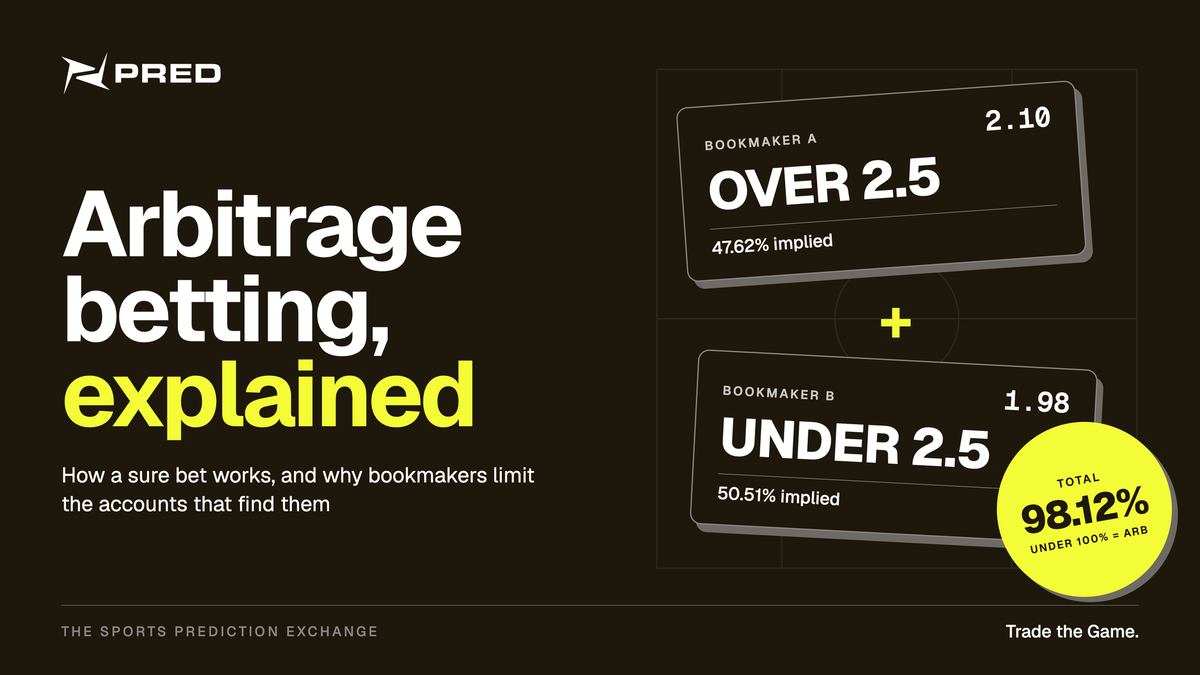
TL;DR: An arb, or sure bet, is a set of bets covering every outcome of an event at prices that add up to less than 100%. Back over 2.5 goals at 2.10 with one bookmaker and under 2.5 at 1.98 with another, split £100 between them, and you collect £101.91 whatever the score. Most arbs pair a bookmaker with an exchange. A University of Zurich study of 11,933 top-flight European matches, from 2004/05 to 2010/11, found back-and-lay arbs in 19.2% of them, against 0.8% for arbs between bookmakers alone. The weak point is the bookmaker: it can cancel a bet after you have placed it, and limit the accounts it identifies as arbers. On Pred, the lay leg is a No contract, and a resting order pays no fee.
What is arbitrage betting?
Arbitrage betting means covering every outcome of an event, using more than one firm, at prices that together return more than you stake whatever happens. The position is called an arb or a sure bet, and the people who hunt them are arbers.
Arbs exist because every bookmaker sets its own prices and builds its own margin into them. On a given match, one firm's price on an outcome can be generous enough to beat another firm's price on the opposite outcome. An exchange gives you a second route: instead of backing every outcome, you back one with a bookmaker and lay it against another customer.
How do you know a price is an arb?
Turn each price into an implied probability by dividing 1 by the decimal odds, then add the probabilities up across every outcome. If the total is below 100%, the prices make an arb. At 100% or above, they don't.
Take a match where bookmaker A offers over 2.5 goals at 2.10 and bookmaker B offers under 2.5 at 1.98. Over at 2.10 implies 47.62%, under at 1.98 implies 50.51%, and the two add up to 98.12%. Every pound you spread across them comes back as £1.0191, a return of 1.91%.
A three-way football market works the same way. Add the implied probabilities of the home win, the draw and the away win, each from whichever firm prices it best, and look for a total under 100%.
How much do you stake on each side?
Split your total stake in proportion to each price's implied probability:
Stake on an outcome = total stake × (1 ÷ its odds) ÷ total implied probability
Return = total stake ÷ total implied probability
Outcome | Firm | Odds | Stake | Return if it wins |
|---|---|---|---|---|
Over 2.5 goals | Bookmaker A | 2.10 | £48.53 | £101.91 |
Under 2.5 goals | Bookmaker B | 1.98 | £51.47 | £101.91 |
You stake £100.00 and collect £101.91 whichever bet wins, a profit of £1.91. Stakes rounded to the penny can leave the two returns a penny apart, so check both before you place anything. The calculator below runs the split for two or three outcomes, for a back and lay on an exchange, and for a bookmaker bet covered with No contracts.
Pick how you are covering the result, enter the prices, and the calculator splits the stakes and shows what you make on every outcome. Decimal odds only.
Stakes are rounded to the penny, so the returns can differ by a penny between outcomes.
Why do most arbs involve an exchange?
The best evidence comes from Egon Franck, Erwin Verbeek and Stephan Nüesch at the University of Zurich, published in Economica in 2013. They set the prices of ten bookmakers against Betfair's for the top five European leagues across seven seasons, from 2004/05 to 2010/11.
Arbs between bookmakers alone were rare: 102 in 12,782 matches, or one in 125, with an average return of 0.9%. Backing with a bookmaker and laying on Betfair produced 2,287 arbs in 11,933 matches, or 19.2%. Those averaged a 1.4% return after allowing for a 5% exchange commission. The authors checked each match's prices once, so they describe their count as conservative.
They give two reasons for the gap. The bookmakers in the sample built an average margin of 11.3% into their prices, while Betfair charged 2% to 5% of net winnings. And a lay covers every other outcome at once, so you never need a second bookmaker to price the rest of the match. Most of the arbs came from bookmaker prices that were too generous next to the exchange price. The authors argue bookmakers post some of those prices on purpose to win customers, because they can identify the ones who profit and limit them later.
The arbs turned up on busy matches, not quiet ones. At the Betfair prices the authors used, arb matches averaged £125,270 traded, against £64,907 across all matches. In 73% of the arbs, more than £10,000 had traded at that price.
How do you arb with a lay on an exchange?
Back the selection with the bookmaker, then lay it on the exchange. The lay stake comes from the same formula as a matched betting qualifying bet, with commission written as a decimal:
Lay stake = back stake × back odds ÷ (lay odds − commission)
Say a bookmaker offers 2.56 on a home win and the exchange lets you lay it at 2.50, with 2% commission. Back £100 at 2.56 and lay £103.23 at 2.50.
Selection wins | Selection doesn't win | |
|---|---|---|
Bookmaker | +£156.00 | −£100.00 |
Exchange lay | −£154.85 | +£101.17 |
Net | +£1.15 | +£1.17 |
That is £1.16 either way once the penny of rounding in the lay stake is set aside, a return close to the 1.4% average in the Zurich data. The exchange holds your £154.85 liability until the match settles, so that money has to be in your exchange balance before you lay.
How do you arb with No contracts on Pred?
On a Yes/No exchange, the lay leg of an arb is a No contract. A No contract on Pred pays $1 if the outcome does not happen, so buying No covers you if the bookmaker bet loses.
Size the position by what the bookmaker would pay you. Buy as many No contracts as the bookmaker bet returns if it wins, stake included:
No contracts = back stake × back odds
The arb test is a single line. Multiply the back odds by the Yes price, which is 1 minus the No price, and you need a result above 1. Put the other way, the No price has to sit below 1 − 1 ÷ back odds. At back odds of 2.56, that ceiling is 60.9p.
Run the bookmaker bet above through Pred at a No price of 60p. A 60p No price is a 40p Yes price, the same as laying at 2.50, the exchange price in the last example.
Selection wins | Selection doesn't win | |
|---|---|---|
Bookmaker, £100 at 2.56 | +£156.00 | −£100.00 |
256 No contracts at 60p | −£153.60 | +£102.40 |
Net | +£2.40 | +£2.40 |
That is £2.40 either way, against £1.16 for the exchange lay at the same price. The difference is the fee. Those figures assume your No order rests on the book until another trader fills it, which makes you the maker, and Pred's fee schedule charges makers nothing.
Buy at a price already on the book and you pay the taker fee: 0.025 × contracts × price × (1 − price). Pred takes it in contracts, so holding 256 means buying 258.59, which costs £155.15 and takes the arb down to £0.85. At this price, taking the order costs £1.55, more than the £1.24 that 2% commission takes off the exchange lay. Resting it costs nothing. The break-even No price is 60.9p for a resting order and 60.3p for one that takes the price.
Resting orders change the order you work in. Post the No order first, at a price that makes the arb work, and place the bookmaker bet once it fills. Placing, amending and cancelling an order on Pred costs nothing, so if the bookmaker price moves before your order fills, cancel and reprice. Keep the gap between the two legs short, because the first one is unhedged until the second is placed. The price Pred displays for a market is its current Yes price, and Pred's docs warn that the spread can stop you trading at it. Size the arb from the order book.
Check the settlement rules on both legs. The football example in Pred's docs settles on 90 minutes plus stoppage time, and keeps a postponed match's market open until the game is played. If your bookmaker voids the bet on a postponed match, your No position is unhedged until then.
Pred contracts pay out in USDC, so convert the bookmaker figure at your deposit rate when you size the order. The examples stay in pounds to keep them comparable. Markets resolve within three to four minutes of the result being confirmed, so the money from one arb is back in your balance for the next. Pred runs the venue and never takes a side, so a profitable account costs it nothing and it has no commercial reason to restrict one. Deposits work in fiat as well as crypto.
Do arbs exist on prediction markets?
Yes, inside a single venue as well as between venues. On a market with several mutually exclusive outcomes, exactly one Yes contract pays $1, so the prices of every outcome's Yes contract should add up to $1. When they don't, the gap is an arb.
A 2025 study by Oriol Saguillo and colleagues measured this on Polymarket, across markets that resolved between 1 April 2024 and 1 April 2025. Of 1,578 multi-outcome markets, 662 had at least one arb. The authors estimate that traders took about $40 million in arbitrage profit over the year, and the most profitable single account made about $2 million. Sports markets threw up the most opportunities for a trader working with a small budget, while the largest profits came from politics, led by the 2024 US election.
Pred lists the home win, the draw and the away win of a football match as separate markets, each with its own Yes and No. That gives a simple check across the three order books:
- If the best prices to buy Yes on the three markets add up to less than $1, buy one Yes on each. One of them pays $1 whatever the result.
- If the best Yes bids add up to more than $1, buy one No on each. The three cost $3 minus those bids, and two of them pay $1, for $2.
Say the best Yes prices are 47¢ on the home win, 27¢ on the draw and 24¢ on the away win. A set of three costs 98¢ and pays $1, a 2¢ gap. Taker fees on those prices come to about 1.6¢ a set, which leaves 0.4¢. As resting orders, the full 2¢ stays yours, provided all three fill before the prices move.
Read the cancellation rule before you buy a set of Yes contracts. The example market in Pred's docs resolves No if the game is cancelled with no rearranged date. A cancellation would settle all three Yes contracts at zero, and pay all three No contracts $1 each.
Why do bookmakers limit arbers?
A bookmaker takes the other side of every bet you place with it, so an arber who keeps taking its most generous prices costs it money. Franck and his co-authors read the terms of all ten bookmakers in their study, as they stood in 2010 and 2011. Every one reserved the right to cancel bets after accepting them, cut stakes and close accounts without giving a reason. William Hill and bet365 told the authors they limit stakes once they identify an arber. A cancelled leg leaves the other one riding on the result, and the arb is gone.
The UK regulator does not count arbers separately. The Gambling Commission's 2025 data request covered almost 15 million active accounts at large online operators and found 4.31% under a commercial restriction. Restricted customers were nearly twice as likely to be in profit: 46.78%, against 25.42% of all active customers. Our guides to gubbing and restricted betting accounts cover what those restrictions look like.
Exchanges work on a different model. They match you with another customer, so the money you win comes from that customer and not from the exchange. Betfair and Smarkets both charge more once an account's profit passes £25,000, but neither restricts stakes for winning.
Is arbitrage betting legal, and is it taxed?
It is legal in the UK. Placing bets with several firms on different outcomes breaks no law, and the limits come from each bookmaker's terms. The Gambling Commission treats account restrictions as a commercial matter for operators.
HMRC does not treat betting as trading, even when it is systematic (BIM22015 and BIM22017), so an individual's arb profits are not taxed. Our matched betting guide covers both points in more detail. This is a summary of the rules, not legal or tax advice.
What can go wrong with an arb?
An arb is only as sound as its weakest leg. These are the ways a matched pair turns into an open position:
- A leg gets cancelled. Bookmaker terms let the firm void a bet after accepting it, which leaves the other leg exposed.
- The bookmaker takes less than you asked. If it accepts a fraction of your stake, your lay or No position is too big, and you have to trim it at whatever price is left.
- The price moves between legs. Place the leg most likely to move first, and drop the arb if the second price has gone.
- The rules differ. Settlement on 90 minutes against extra time, postponement rules and void rules can treat the same event differently at each firm.
- The money isn't there. An exchange or Pred order book can hold less than you need at the arb price.
- Your balance is tied up. Exchange liability and the cost of No contracts sit in your account until the match settles.
- Live orders wait. Pred holds orders placed during a live match for about three seconds before they reach the book. Smarkets delays in-play bets on football by eight seconds unless the market runs on its Instant Match system. A live arb can close in that time.
- Costs eat thin margins. The Zurich arbs averaged 1.4%, so test every one after commission and fees. The calculator above does both.
Trading carries risk. A position can settle at a total loss, and none of the figures above is a forecast of returns.
Common questions
Is arbitrage betting legal in the UK?
Yes. Placing bets with several firms on different outcomes of the same event breaks no UK law. The limits are contractual: bookmakers' terms let them cancel bets after accepting them, cut stakes and close accounts without giving a reason. The Gambling Commission treats those restrictions as a commercial matter for operators.
Can you get banned for arbitrage betting?
A bookmaker can limit or close your account, and arbing is one of the patterns it looks for. In a University of Zurich study published in 2013, William Hill and bet365 confirmed they limit stakes once they identify an arber. Betfair and Smarkets charge winning accounts more instead of cutting stakes, and Pred's fees do not change with an account's results.
How much can you make from arbitrage betting?
Arb margins are thin. In the Zurich study of top-flight European football from 2004/05 to 2010/11, back-and-lay arbs averaged a 1.4% return and arbs between bookmakers averaged 0.9%. On £100, that is £1.40 or 90p before fees. What you make over time depends on how long your bookmaker accounts stay unrestricted.
Is arbitrage betting risk-free?
No. The prices remove the match result from the equation, but a bookmaker can cancel one leg after you place the other, or accept only part of your stake. Prices can move between legs, firms settle some events under different rules, and a live order can wait seconds before it reaches the book.
How do you calculate an arb?
Divide 1 by the decimal odds of each outcome and add the results. A total below 100% is an arb. Stake on each outcome the total stake times 1 over its odds, divided by that sum. Every outcome then returns the total stake divided by the sum, whatever happens.
Do arbs exist on prediction markets?
Yes. A 2025 study of Polymarket found arbs in 662 of 1,578 multi-outcome markets that resolved between April 2024 and April 2025. Its authors estimate traders took about $40 million from them. On a market where exactly one outcome pays $1, the Yes prices should add up to $1, and any gap is an arb.