
Value betting explained
TL;DR: A value bet is a price that pays more than the outcome's real chance is worth. Multiply the decimal price by the probability, and anything above 1 is value. The hard part is the probability, so we tested what works on 7,980 Premier League matches from 2005/06 to 2025/26. Taking the best price in the market cut the cost of backing every outcome from 7.2p per £1 at the average price to 1.2p. Best Friday prices that beat Pinnacle's closing price, margin removed, returned 7.6p per £1 across 7,902 outcomes from 2012/13 and made money in all 14 seasons. The rest lost 8.8p. Academics who staked real money on a value strategy were limited by bookmakers within months. On Pred the price is the probability, and Pred never takes the other side.
A value bet can lose. Value is a property of the price: a price is value when it pays more than the outcome's chance is worth, and across enough bets that gap decides whether you finish ahead.
This guide covers how to tell value from a price, where the real probability comes from, what 21 Premier League seasons of prices show, and why bookmakers limit the customers who find it. The data is football-data.co.uk's results and prices for every Premier League match from 2005/06 to 2025/26.
What is value betting?
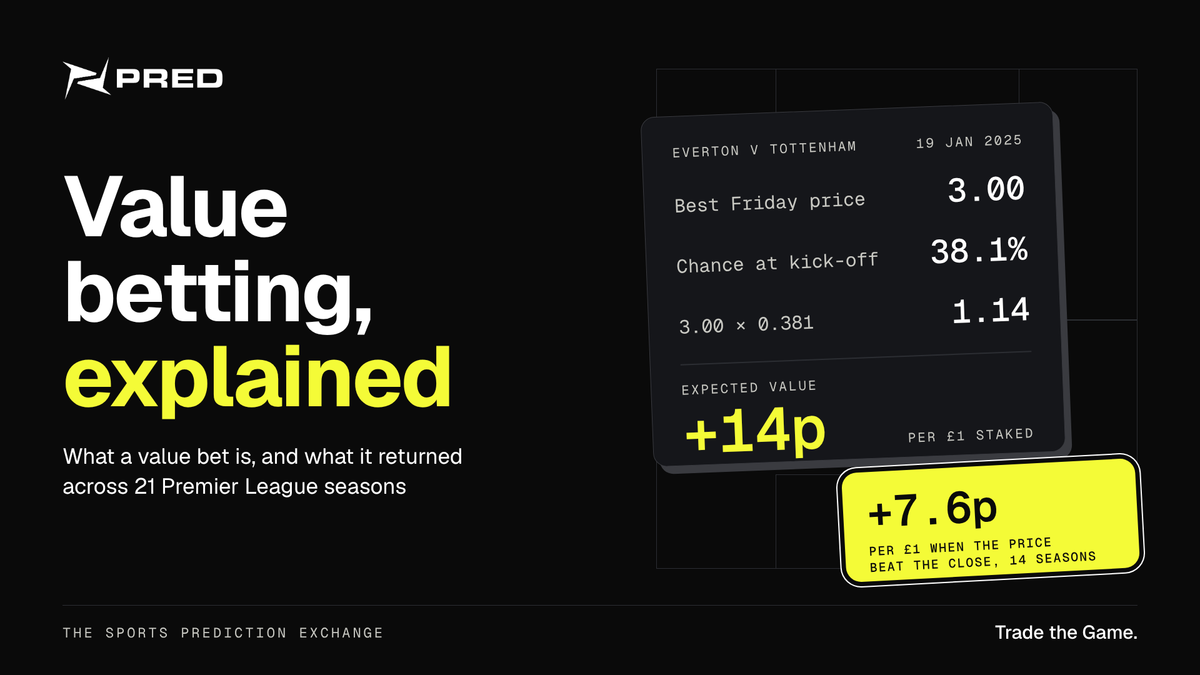
Value betting means backing an outcome at a price that pays more than its real chance is worth. A decimal price of 3.00 returns £3 for every £1 staked, which is fair for an outcome that happens one time in three. If the real chance is 38%, 3.00 is value. If it is 30%, the same price loses money over time.
The test is one multiplication: decimal price × probability. A result above 1 means positive expected value, exactly 1 is a fair price, and anything below 1 loses on average.
Take Everton against Tottenham on 19 January 2025. On the Friday before the match, the best price in the market on an Everton win was 3.00. By kick-off Pinnacle had cut Everton to 2.56, which is a 38.1% chance once its margin is taken out. At 3.00, a 38.1% chance is worth 3.00 × 0.381 = 1.14 per £1 staked: 14p of expected profit. Everton won 3-2.
Value bets lose often. On 2 February 2025 the best Friday price on Manchester United at home to Crystal Palace was 2.08. Pinnacle closed United at 1.78, a 54.5% chance with its margin removed, so 2.08 was worth 2.08 × 0.545 = 1.13: 13p of expected profit per £1. Crystal Palace won 2-0.
How do you work out the expected value of a bet?
Multiply the decimal price by the probability you give the outcome, then subtract 1. The answer is your expected profit per £1 staked, averaged over many bets like this one.
Expected value per £1 = decimal price × probability − 1
At 3.00 and 38.1%, that is 3.00 × 0.381 − 1 = 0.143, or 14.3p per £1. At 2.50 the same 38.1% gives −4.8p, so a shorter price on the same outcome stops being value.
Turned round, the formula gives the shortest price worth taking: 1 ÷ probability. A 38.1% chance needs a price longer than 2.62. Any shorter and there is no value, however good you think the team is.
To turn a price into the chance it implies, divide 1 by it: 3.00 implies 33.3%. A bookmaker's implied chances for a match add up to more than 100%, and the excess is its margin. Our guide to betting odds covers the conversions.
Where does the real probability come from?
From one of three places: your own forecast, the market's consensus, or the closing price of a low-margin bookmaker.
Your own forecast has to beat the bookmakers' models, which are built on the same data and more. In 2017 Lisandro Kaunitz, Shenjun Zhong and Javier Kreiner wrote that they knew of no published model that had beaten the betting market consistently (Kaunitz, Zhong and Kreiner, 2017).
The market's consensus is the average price across many bookmakers. The same researchers took the average closing price of 32 bookmakers across 479,440 matches in 818 leagues. Once they allowed for the margin, it tracked how often outcomes happened almost exactly. Our own check of 21 Premier League seasons found results landed within 0.7 percentage points of the margin-free price, on average (how accurate betting odds are).
The third is a closing price, the last before kick-off, from a bookmaker that runs a low margin. Pinnacle had the lowest margin of the bookmakers in the data: 2.95% at kick-off in 2025/26, against 5.59% for Bet365. By kick-off its price has taken in the week's team news and money.
How much does taking the best price save?
More than four-fifths of the cost. We backed every outcome of every match at the market's average Friday price, £1 a time, and again at the best Friday price on offer. Over 21 seasons the average price lost 7.2p per £1 and the best price lost 1.2p.
| Prices taken | 2005/06 to 2018/19 | 2019/20 to 2025/26 | All 21 seasons |
|---|---|---|---|
| Market average | −8.5p | −4.5p | −7.2p |
| Best price in the market | −2.0p | +0.2p | −1.2p |
Return per £1 staked on every outcome of every match at Friday prices: 23,940 outcomes in 7,980 matches. Football-data built its average and best prices from Betbrain's bookmakers until 2018/19 and from a different set after that, so the two periods don't compare directly.
Since 2019/20 the best price broke even on its own: +0.2p per £1, with a 95% range of −3.7p to +4.2p. Bet365's Friday prices lost 6.0p per £1 over the 21 seasons, about five times the best price's loss.
Taking the best price needs accounts with several bookmakers, and Betbrain's figures drew on between 36 and 58 bookmakers a match, depending on the season.
Can a simple screen find value bets?
Not in the Premier League, on our tests. The 2017 study backed the best price whenever it was longer than 1 ÷ (consensus probability − 0.05), where the consensus probability is 1 divided by the average price. Across 818 leagues it found 56,435 bets in 479,440 matches at closing prices, and returned 3.5%. In the Premier League it found 65 bets in 7,980 matches at Friday prices, and 49 in the 2,660 matches since 2019/20 at closing prices: under 2% of matches either way. Both sets lost money, and both are too small to judge.
A looser screen finds more bets and no value. Take the margin out of the average price, treat the result as the fair price, and back the best price whenever it is longer. Over 21 seasons that picks 7,146 bets, 59% of them away wins and 43% at prices above 5.00. They lost 1.3p per £1, close to what the best price lost on every outcome. Bookmakers put more of their margin on outsiders, so taking it out evenly leaves outsiders looking more likely than they are, and the screen reads that as value (where the margin sits).
What is closing line value?
Closing line value is how much better the price you took was than the closing price, the last one before kick-off. In our data it is the clearest sign of value. We checked the best Friday price on every outcome from 2012/13 against Pinnacle's closing price with its margin removed. The 7,902 Friday prices that beat it returned 7.6p per £1, with a 95% range of 3.3p to 11.9p. The 7,548 that didn't lost 8.8p per £1. The split held in every season.
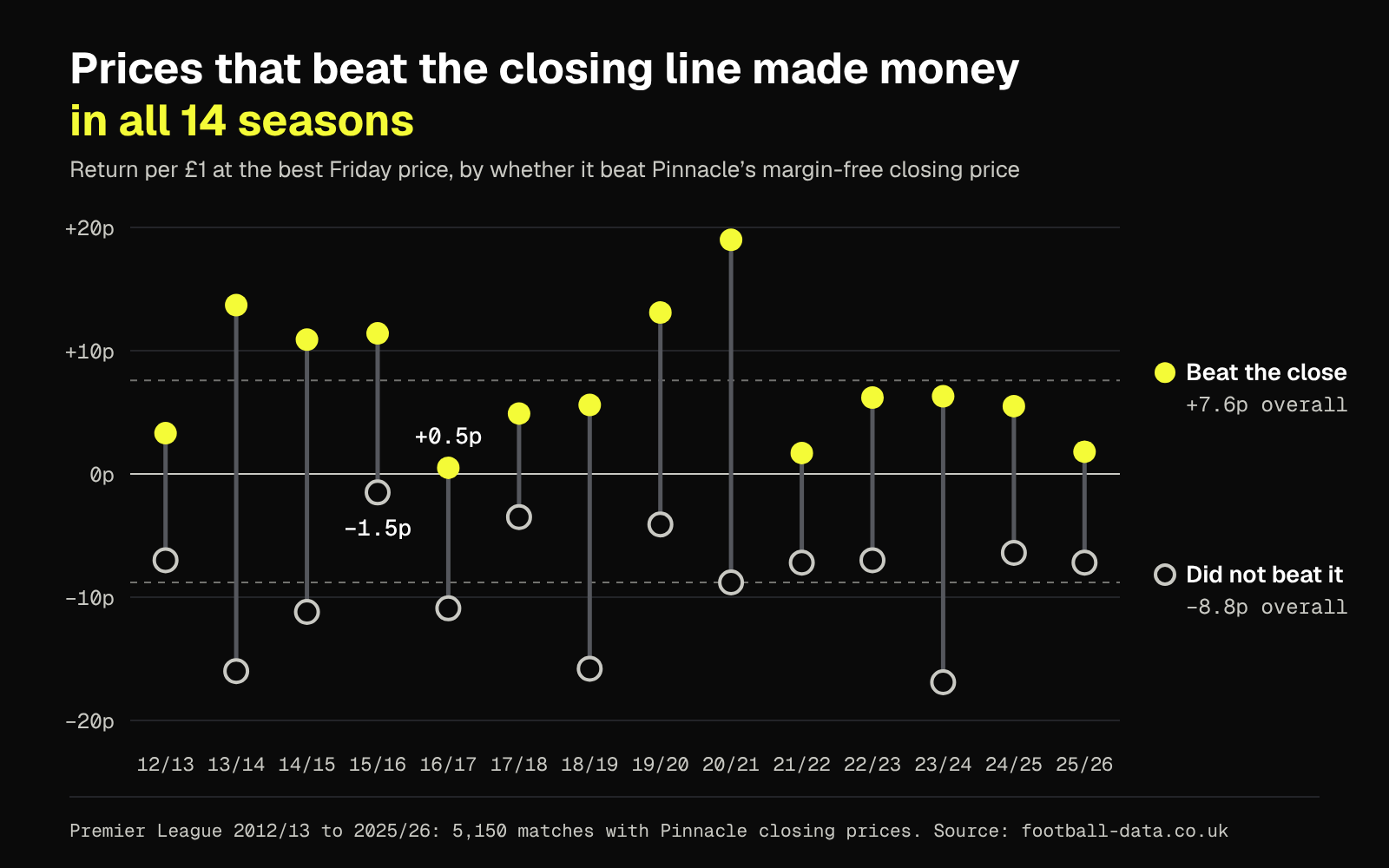
Prices that beat the closing line made money in all 14 seasons: return per £1 at the best Friday price, by whether it beat Pinnacle's margin-free closing price. Source: football-data.co.uk, 2012/13 to 2025/26, 5,150 matches with Pinnacle closing prices (210 of 380 in 2025/26).]
Bet365's Friday prices showed the same split on a smaller scale. The quarter of them that beat Pinnacle's close returned 3.2p per £1, and the rest lost 7.6p.
This is hindsight: on the Friday nobody knows the closing price. Used afterwards, it checks your prices without waiting for results. Record each price you take and compare it with the close. If your prices keep beating it, you are finding value, even in a season when results go against you. Bet365's prices that beat the close still lost money in 4 of the 14 seasons.
Why do bookmakers limit value bettors?
A bookmaker takes the other side of every bet it accepts, so a customer who keeps finding value costs it money. Kaunitz, Zhong and Kreiner found that out with $50 bets. After three months of paper trading, they staked real money for five months: 265 bets, $957.50 of profit, an 8.5% return. A few months in, bookmakers began limiting their accounts. Some cut their stakes and some held bets for manual checks. In most cases the bookmaker refused the bet or offered less than $50, and the researchers stopped.
The limits started inside those five months, on a record far too short to prove an edge. Across all 672 paper and real bets, the researchers put the chance of a random strategy doing as well at 1 in 11.
The UK regulator's figures show how common restrictions are. In early 2025 the Gambling Commission asked some of the largest online betting operators about 14,923,840 accounts that had bet in 2024. Of those, 4.31% were restricted in some form. Over the life of the account, 46.78% of restricted customers were in net profit, against 25.42% of all active customers. Of the accounts with a cut maximum stake, 22.41% were down to 1% or less of the normal maximum (Gambling Commission). The Commission says operators are entitled to manage their liabilities, and that it can't mandate how they do it. Our guides to gubbing and restricted betting accounts cover what those limits look like.
How does value work on Pred?
On Pred, a sports prediction exchange, the price is the probability, so there is nothing to convert. A Yes contract at 40¢ pays $1 if the outcome happens and nothing if it doesn't, and it is value if you put the chance above 40% (how Pred prices markets).
Expected value per contract = your probability − price − fee
There is no margin built into the price. When a Yes buyer and a No buyer are matched, what they pay adds up to $1. The cost of trading sits outside the price: in the spread between the best bid and the best offer, and in a fee on the side that takes a price. Pred's fee schedule, which its docs list as launching soon, charges takers 0.025 × contracts × price × (1 − price), deducted in contracts when you buy. Makers, whose orders rest on the book until another trader fills them, pay nothing.
That keeps the bar for value low. Buying Yes at 40¢ by taking the price breaks even if the outcome happens 40.6% of the time. With a resting order at 40¢, it breaks even at 40%. On a sportsbook the margin sits inside the price: Bet365's Friday prices on 2025/26 Premier League matches added up to 105.5% on average.
Value works in both directions. If you think the market has a favourite priced too short, buy No. A No contract at 35¢ is the same position as laying the favourite at 1.54 (how laying works).
Pred runs the venue and never takes a side, so a profitable account costs it nothing and it has no commercial reason to restrict one. Its fees don't change with an account's results. The closing-price check works here too: note the price you traded at and compare it with the last price before kick-off.
How do you trade value on Pred?
- Sign up with email or Google, and Pred creates a non-custodial wallet for you. Deposit in US dollars or euros, or transfer USDC. The minimum deposit is $1.
- Put your own number on the outcome before you look at the price.
- Compare it with the Yes price. Buy Yes if the price is below your number by more than the fee. Buy No if it is above your number by more than the fee.
- Place a limit order at the price you want (order types). If it rests on the book until another trader fills it, you pay no fee.
- Write down the price you got and compare it with the last price before kick-off.
- Sell some or all of the position before or during the match at the best bid, minus a small fee, or hold to full time. Winning contracts pay $1 each.
Orders on Pred match in 200ms, and markets resolve within three to four minutes of the result being confirmed.
Trading carries risk. A position can settle at a total loss, and none of the figures above is a forecast of returns.
Common questions
What is a value bet?
A value bet is a bet at a price that pays more than the outcome's real chance is worth. Multiply the decimal price by the probability: above 1 is value. At 3.00, an outcome with a 38.1% chance is worth 1.14, so the bet expects 14p of profit per £1 staked, averaged over many bets like it.
How do you calculate value in betting?
Expected value per £1 = decimal price × probability − 1, and a positive answer is value. The shortest price worth taking is 1 ÷ probability, so a 40% chance needs a price longer than 2.50. On Pred the price is the probability, and a taker buying Yes at 40¢ breaks even at a 40.6% chance after the fee.
Does value betting work?
Where the price beat the closing line, yes. Best Friday prices that beat Pinnacle's margin-free closing price returned 7.6p per £1 across 7,902 outcomes from 2012/13 to 2025/26, and made money in every season. Simple screens comparing the best price with the market average found little or no value.
What is closing line value?
Closing line value is how much better your price was than the closing price, the last before kick-off. Across 14 Premier League seasons, best Friday prices that beat Pinnacle's margin-free close returned 7.6p per £1, and those that didn't lost 8.8p. Comparing your prices with the close shows whether you are finding value, even in a season when results go against you.
Why do bookmakers limit value bettors?
A bookmaker takes the other side of every bet, so a customer who keeps finding value costs it money. In a 2017 study, researchers who staked real money on a value strategy had their accounts limited within months. UK Gambling Commission data shows 46.78% of restricted customers were in net profit, against 25.42% of all active customers.
Is value betting legal?
Yes. Taking a price you think is too big breaks no UK law. The limits come from each bookmaker's terms, and the Gambling Commission says operators are entitled to act in their commercial interests and manage their liabilities.
Can you value bet on a prediction exchange?
Yes. On Pred the price is the market's implied probability. A Yes contract priced below the chance you give the outcome is value, and so is a No contract when the Yes price is above it. Takers pay a fee of 2.5% × (1 − price) of what they spend, and resting orders pay nothing. Pred never takes a side, so a winning account costs it nothing.