
Football trading explained: how a trade makes money before full time, and what 21 Premier League seasons show
TL;DR: Football trading means opening a position on a match and closing it before full time, so the profit comes from the price move. In 4,940 Premier League matches, the biggest Friday-to-kick-off move was 1.9 points of probability at the median. When the underdog led at half-time, 23.9% of matches still ended level.
A trader treats a match as a market that stays open from the day it lists until the final whistle. You buy when a price looks too low and sell once it rises, and the full-time score settles only the positions you still hold.
This guide covers how a trade makes money, how to green up, the main strategies and what they cost. It checks what two of them depend on against 21 seasons of Premier League prices and results, 7,980 matches in all, from football-data.co.uk.
What is football trading?
Football trading is buying and selling positions on a match before it finishes. A trader profits when the price moves their way between buying and selling. A bettor profits only when the result goes their way.
It needs a venue where you can sell as well as buy. On a betting exchange such as Betfair, you back a selection to open a position and lay it to close, or the reverse (how laying works). On Pred, a sports prediction exchange, you buy Yes or No contracts priced in cents between $0 and $1, then sell them to other traders. Pred's guide to a first trade says you can close a position at any time.
A bookmaker's cash out also closes a position early, but the bookmaker sets the price (how cash out is priced). On an exchange, other traders set it.
How does a football trade make money?
Profit is the gap between the price you buy at and the price you sell at, multiplied by the size of the position. Close before full time and the result never enters the sum.
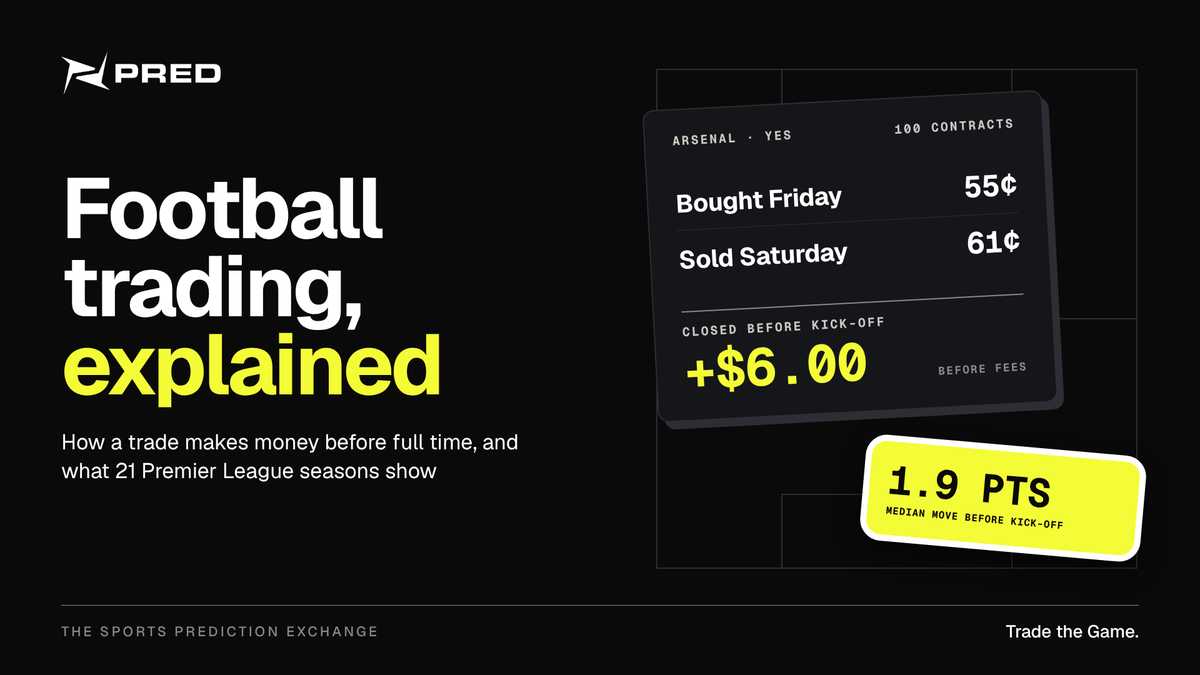
Say Arsenal are at home on Saturday, and on Friday the Arsenal Yes contract trades at 55¢ on Pred. You buy 100 contracts for $55. Team news on Saturday morning lifts the price to 61¢, and you sell all 100 for $61. That is a $6 profit before fees, whether or not Arsenal go on to win.
If the price had fallen to 50¢ instead, selling would lock in a $5 loss. Holding to full time hands the decision back to the match: each contract pays $1 if Arsenal win and nothing if they don't.
On Pred the price is the market's implied probability (how Pred prices markets), so the profit per contract is the move in cents. A rise from 55¢ to 61¢ is 6 cents, or 6 percentage points of probability. The rest of this guide measures moves the same way: one point is one cent on a $1 contract.
What does greening up mean?
Greening up means closing a position so you make the same profit whatever the result. It is the exchange trader's version of hedging.
On a betting exchange, you green up by laying what you backed, at a stake that evens out every outcome:

Back Arsenal for £100 at 2.00 on Friday. They shorten to 1.80 by kick-off, so you lay £111.11 at 1.80. If Arsenal win, the back makes £100 and the lay costs £88.89. If they don't, the back loses £100 and the lay keeps £111.11. You are £11.11 up either way, before commission.
On Pred there is no stake to work out. Selling the contracts you hold closes the position at the best bid on the order book. Pred's cashout page says you can sell any percentage of a position at any point, minus a small fee.
What moves football prices?
News that changes the chance of an outcome. Before kick-off that means team news, injuries and the weight of money from other traders. During a match it means goals, red cards, penalties and the clock.
The clock moves prices even when nothing happens. At 0-0, each minute without a goal makes a draw more likely, so the draw price rises and both teams' prices fall. Traders call this time decay.
Goals are the biggest shock, and markets absorb them fast. Karen Croxson and James Reade studied high-frequency betting prices around goals scored just before half-time and found that prices adjusted quickly and completely (The Economic Journal, 2014). The profit from a goal goes to whoever held the right position before it went in, since anyone buying afterwards pays the new price.
How far do football prices move before kick-off?
In the median Premier League match, the biggest of the three prices moved 1.9 points. We compared match-result prices collected on Friday afternoon (Tuesday for midweek games) with the closing prices at kick-off, for 4,940 matches from August 2012 to May 2025. The prices are Pinnacle's, a bookmaker whose margin averaged 2.4% across these matches. We removed that margin from both sets before comparing them.
- At least one price moved 3 points or more in 27.5% of matches, and 5 points or more in 7.9%.
- Moves of 10 points or more came in 22 of the 4,940 matches.
- The draw moved least, with a median shift of 0.7 points, against 1.6 for the home side and 1.4 for the away side.
- Direction was close to a coin toss. The home side's implied probability rose in 48.2% of matches and fell in 51.7%.
Betfair Exchange prices for the last two seasons, 738 matches, show the same picture. The median biggest move was 2.0 points, and 9.8% of matches had a move of 5 points or more.
The moves carried information. Selections whose price rose by 5 points or more went on to win 50.8% of the time, against 43.4% implied on Friday. Selections that fell by 5 points or more won 39.5% of the time, against 46.8% on Friday. Across all 4,940 matches, kick-off prices scored better than Friday's on both standard accuracy measures, the Brier score and log loss.
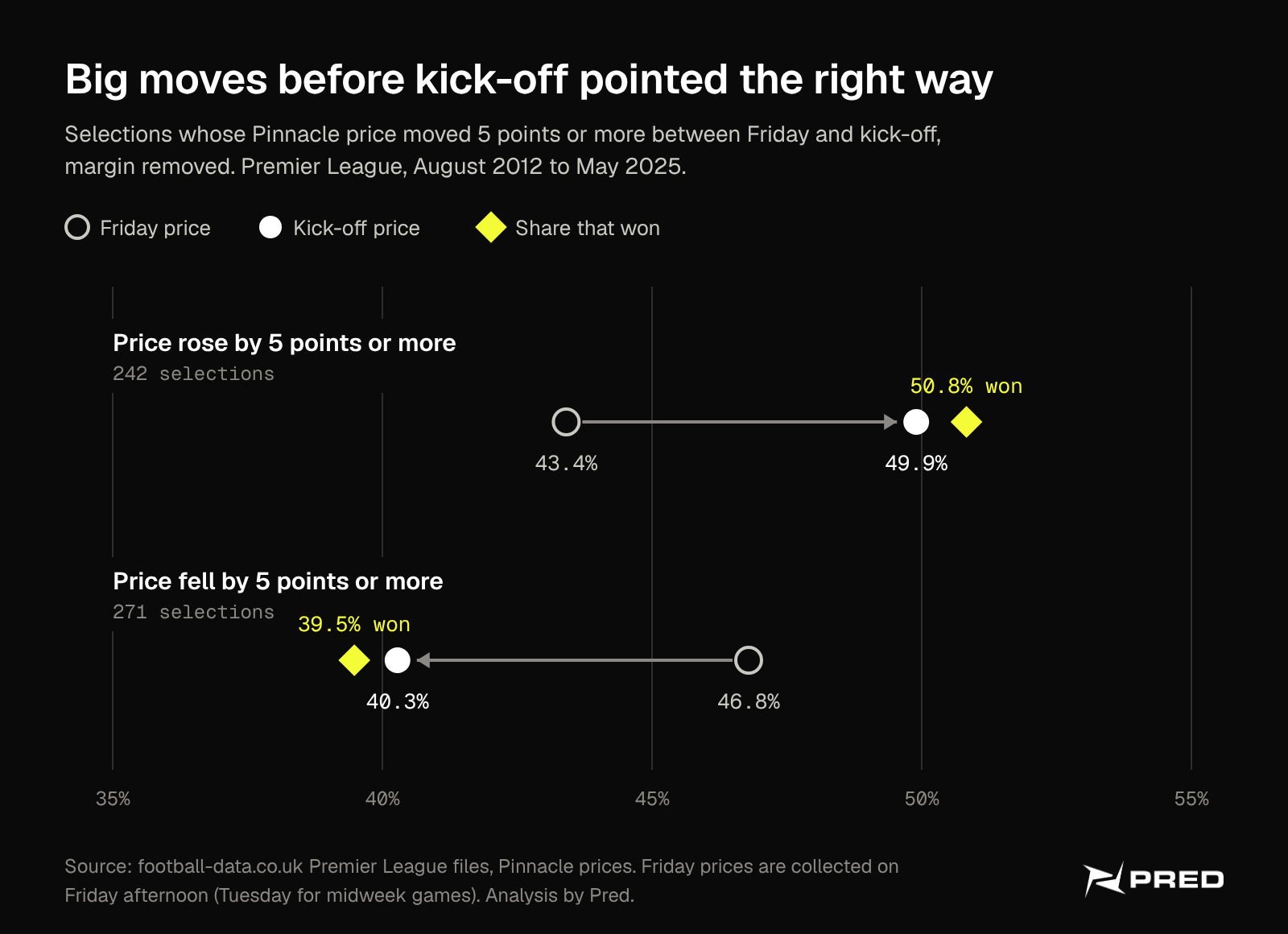
A trader who gets ahead of a big pre-match move catches a change that the results backed up in this data. A trader who guesses the direction is calling a split that ran 48 to 52, and pays the spread and any fee on each trade that takes a price.
What is lay the draw?
Lay the draw is a football trading strategy built on one event: a goal. You take a position against the draw before kick-off or early in the match. A goal makes the draw less likely, its price falls and you close for a profit. If the match stays goalless, the draw price climbs and the position loses value.
On a betting exchange you lay the draw. On Pred you buy No on the draw. Pred's football match markets list three outcomes, home, draw and away, each with its own Yes and No. They settle on the score after 90 minutes plus stoppage time (resolution rules). A No on the draw pays $1 if either team wins.
Here is the trade at illustrative Pred prices. The draw trades at 24¢ before kick-off, so No costs 76¢, and you buy 100 No contracts for $76. The favourite scores in the 30th minute and the draw falls to 18¢, so No rises to 82¢. Selling all 100 returns $82, a $6 profit before fees.
The draw starts out priced close to fair. Across our 4,940 matches, Pinnacle's kick-off prices with the margin removed gave the draw a 24.3% chance, and 23.6% of the matches ended level. That leaves a gap of 0.7 points before the spread and fees, so the trade has to earn its profit in how it is managed.
How often the goal comes, from all 7,980 Premier League matches between 2005/06 and 2025/26:
- 92.8% had at least one goal, and 7.2% finished 0-0.
- 29.3% were goalless at half-time. A quarter of those, 24.5%, stayed goalless.
- 70.4% of draws were score draws, 1-1 or higher, so in each one a lead was wiped out.
Which team scores matters too. We split the 7,922 matches in which Bet365's Friday prices made one side favourite by the score at half-time.
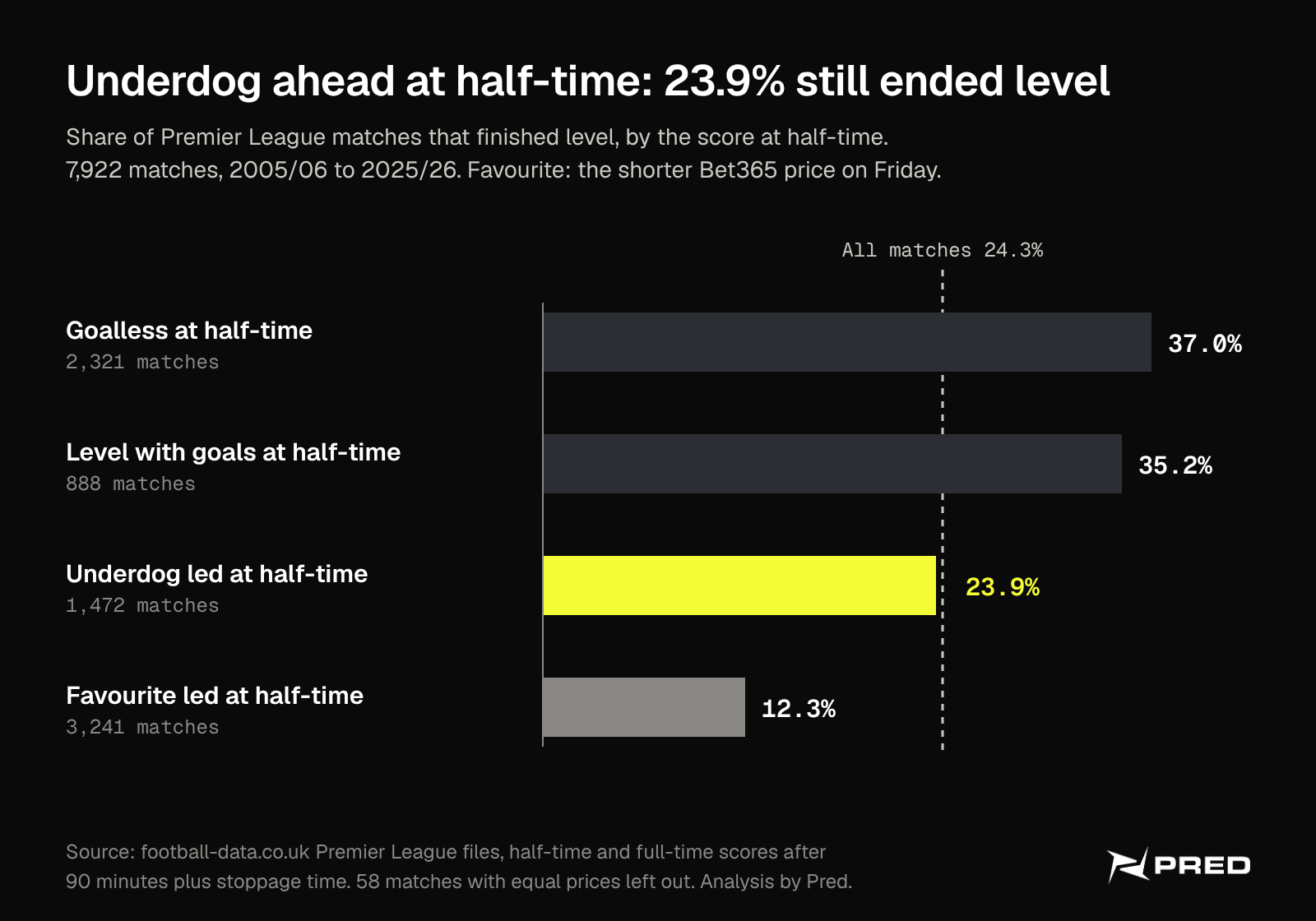
When the favourite led at half-time, 12.3% of matches ended level, and a one-goal favourite lead left 16.8%. When the underdog led, 23.9% did, against 24.3% across all 7,922. A goalless first half pushed the figure to 37.0%.
For a trader against the draw, a favourite's half-time lead halved the chance of a draw. An underdog's lead left it close to where it started. When the underdog led by one goal at half-time, the favourite finished level or ahead in 46.4% of those matches. A goalless first half left the trader holding a position against an outcome that had become half as likely again.
Which football trading strategies do traders use?
Five common strategies, and the Pred version of each:
Strategy | What has to happen | On a betting exchange | On Pred |
|---|---|---|---|
Pre-match swing | The price moves before kick-off, on team news or money | Back early and lay before kick-off, or the reverse | Buy Yes or No early, sell before kick-off |
Lay the draw | A goal, best of all from the favourite | Lay the draw | Buy No on the draw |
Overs | Goals arrive early | Back Over 2.5 Goals | Buy Yes on Total Over 2.5 Goals |
Unders | The clock runs with few goals | Lay Over 2.5 Goals or back Under 2.5 Goals | Buy No on Total Over 2.5 Goals |
Scalping | Many small price moves | Many small back and lay trades | Limit orders on both sides of the book |
Overs and unders depend on how many goals a league produces. Over 2.5 goals landed in 52.3% of Premier League matches across the 21 seasons, from 45.0% in 2005/06 to a high of 64.7% in 2023/24. The 2025/26 season finished at 55.0%.
What does football trading cost?
Two costs can apply to a trade. The first is the spread, the gap between the best price to buy and the best price to sell. A market order crosses it, and a limit order that waits on the book does not. The second is the venue's fee.
Betfair charges commission on your net winnings in each market. Its Expert Fee, in force since 6 January 2025, adds a charge for accounts with more than £25,000 of gross profit over their last 52 active weeks. It lifts their total charges to 20% of gross profit while their 52-week gross profit is between £25,000 and £100,000, and to 40% once it passes £100,000. Betfair says fewer than 0.5% of its customers pay it.
Pred's fee schedule, which its docs list as launching soon, charges only the side that takes a price. The fee is 2.5% × price × (1 − price) per contract, so it peaks at 50¢ and shrinks towards either end. An order that rests on the book until another trader fills it pays nothing. Pred's docs also say traders can never be limited or banned for winning.
On the Arsenal trade, market orders on both legs pay $1.21 in fees at those rates. Limit orders on both legs pay nothing, once other traders fill them.
Is football trading profitable?
Nothing in this data points to a strategy that makes money on its own. Before kick-off, the home side's probability rose in 48.2% of matches and fell in 51.7%, and the kick-off price was the better forecast. During a match, prices absorb goals quickly. The trades that pay come from being early and right: acting on information the market has not priced yet, or holding the right position before a goal. Every trade that takes a price then pays the spread and any fee.
Where you trade decides whether you can keep winning, because bookmakers restrict accounts in profit more often than others. The Gambling Commission collected data from some of the largest online operators on accounts active in 2024. Of the restricted customers, 46.78% were in profit over their lifetime, against 25.42% of all active customers. Those operators reported 643,779 accounts restricted in some form (why accounts get restricted). On an exchange, the other side of every position is another trader, and the venue earns its fee whichever side wins.
How do you trade football on Pred?
- Sign up with email or Google, and Pred creates a non-custodial wallet for you. Deposit in US dollars or euros, or transfer USDC. The minimum deposit is $1.
- Pick a match. Pred lists football from the Premier League, La Liga, Serie A, the Bundesliga, Ligue 1, the Champions League, the Europa League, the EFL Championship, MLS and other leagues.
- Choose a market: match result (home, draw or away), both teams to score, total goals or winning margin.
- Buy Yes or No. A market order fills at once at the best available price. A limit order sets your price, waits on the book and pays no fee when it fills.
- Sell some or all of the position whenever you like, before or during the match. Orders placed during a live match go through a 3-second delay.
- Or hold to full time. Winning contracts pay $1 each, and markets resolve within three to four minutes of the result being confirmed.
Common questions
What is football trading?
Football trading is buying and selling positions on a football match before it finishes, so the profit comes from the price moving rather than from the result. Traders use betting exchanges such as Betfair, where they back and lay, or prediction exchanges such as Pred, where they buy and sell Yes and No contracts.
What does green up mean in football trading?
Greening up means closing a position so the profit is the same whatever the result. On a betting exchange, you lay what you backed at a stake of back stake × back odds ÷ lay odds. On Pred, selling the contracts you hold closes the position at the best bid on the order book.
How does lay the draw work?
You take a position against the draw, then close it after a goal makes the draw less likely. In 7,980 Premier League matches, 92.8% had a goal. Who scored mattered: when the favourite led at half-time, 12.3% of matches ended level, against 23.9% when the underdog led.
Is lay the draw profitable?
The draw price is close to fair, so the profit has to come from the trade itself. Across 4,940 Premier League matches, margin-free kick-off prices gave the draw a 24.3% chance and 23.6% ended level, a gap of 0.7 points before the spread and fees. Entry price, who scores and when you close decide the rest.
How much do football prices move before kick-off?
The biggest of the three prices moved 1.9 percentage points in the median match. That comes from comparing Friday prices with kick-off prices across 4,940 Premier League matches from August 2012 to May 2025. At least one price moved 5 points or more in 7.9% of matches, and kick-off prices predicted results better than Friday's.
Can you trade football in-play?
Yes. Betting exchanges and Pred keep football markets open during matches, so you can close a position before the final whistle. Betfair delays in-play orders by 1 to 12 seconds so customers can cancel unmatched orders. On Pred, orders placed during a live match go through a 3-second delay.
What is the difference between trading and cash out?
At a bookmaker, cash out closes a position at a price the bookmaker sets. On an exchange or on Pred, where the feature is also called cashout, you close by selling to other traders at the prices they bid. You can also set your own exit price with a limit order.
Do you need a crypto wallet to trade on Pred?
You don't need one of your own. Sign up with email or Google and Pred creates a non-custodial wallet for you. Deposits can be made in US dollars or euros as well as USDC, from $1. Positions are priced in cents on a $1 contract and settle in USDC on Base.
How we tested
The data is football-data.co.uk's Premier League files for 21 seasons, 2005/06 to 2025/26: 7,980 matches with half-time and full-time scores, plus bookmaker and exchange prices.
- Price moves. Pinnacle's match-result prices from August 2012 to May 2025, from the 4,940 matches with all six prices. The Friday price is the pre-closing price football-data.co.uk collects on Friday afternoon for weekend games and Tuesday afternoon for midweek games (notes). The kick-off price is the closing price. We removed the margin by scaling each set of three implied probabilities to add up to 100%. One point is one percentage point of implied probability.
- Check. The same test on Betfair Exchange prices for 2024/25 and 2025/26, from the 738 matches with all six prices.
- Accuracy. The Brier score is the squared error of the three probabilities against the result, averaged across matches. Log loss is the negative log of the probability given to the actual result. Friday prices scored 0.5642 and 0.9539, kick-off prices 0.5621 and 0.9508. Lower is better on both.
- Draw pricing. Pinnacle's margin-free kick-off probability for the draw, averaged across the 4,940 matches, against the share that ended level.
- Goals and draws. Half-time and full-time scores for all 7,980 matches. The full-time score is the score after 90 minutes plus stoppage time, which is what Pred's football markets settle on.
- Half-time state. The favourite is the side with the shorter Bet365 price on Friday. 58 matches with equal home and away prices were left out, leaving 7,922.
- 2025/26 Pinnacle prices. We left them out. They stop on 8 January 2026, and football-data.co.uk warns that Pinnacle prices collected since 23 July 2025 are out of date relative to other bookmakers'. Adding back the 210 matches that have them leaves every finding in place.
- Limits. The data holds one pre-closing and one closing price per match, so it cannot show moves in between or during the match. The lay-the-draw figures are outcome frequencies, not traded prices.
- Pred. Sign-up, deposits, market types, fees, order types, cashout and resolution rules come from Pred's docs, and resolution timing from Pred's post on settlement. The three-way football market structure and the list of leagues come from Pred's public market API, checked on 28 October 2026.
Sources: football-data.co.uk Premier League data, notes and data page · Croxson and Reade (2014), Information and Efficiency: Goal Arrival in Soccer Betting, The Economic Journal 124(575), 62 to 91 · Gambling Commission: Commercial restrictions by betting operators (23 July 2025) · Betfair: charges · Betfair: Expert Fee FAQs · Betfair Developer Support: in-play delays · Pred docs: core concepts, sign-up, first trade, deposits, market types, resolution, order types, cashout, fees · Pred: What happens in the 200ms after a goal · Pred public market API. All checked 28 October 2026.